行
Character Story & Explanation
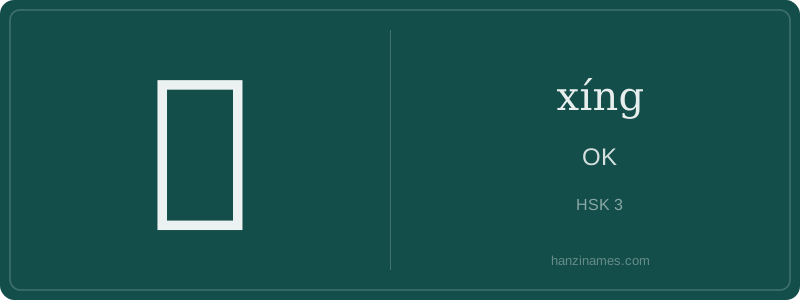
行 is ubiquitous in modern Chinese life: it’s the go-to word for agreement ('Xíng!' = 'OK!'), used constantly in texts, calls, and negotiations. It appears in key idioms like 言行一致 (yán xíng yī zhì, 'words and deeds match') and in official terms like 执行 (zhí xíng, 'to implement'). Historically, 行 first appeared in bronze inscriptions (c. 11th–3rd century BCE) as a pictograph of a crossroads — symbolizing movement and choice. The original form depicted two intersecting paths (the two 'crossbars') with a central path (vertical stroke), emphasizing direction and passage.
The earliest verified form shows clear road-like symmetry — not abstract lines, but a deliberate representation of intersecting routes. This crossroads origin directly supports its core meanings: movement through space, progression of action, and even metaphorical 'paths' in behavior or policy.
Hi students! The character 行 (xíng) is a versatile, high-frequency word at HSK Level 3. At its core, it means 'to walk' or 'to travel' — think of moving your feet forward on a path. But in modern Chinese, it’s used far beyond physical movement: it expresses action ('to do', 'to carry out'), capability ('capable', 'can handle it'), and even affirmation ('OK', 'alright'). Its flexibility makes it essential for daily conversation and formal writing alike.
Notice that 行 has no alternate pronunciation in standard Mandarin — unlike many characters, xíng is its only official reading (though historically, the homophone háng exists for the *noun* meaning 'row' or 'trade', written with the same character but treated as a different lexical item). This simplifies learning: one sound, multiple rich meanings — all connected by the idea of forward motion or functional effectiveness.
As a radical, 行 appears in characters related to movement or conduct — like 徒 (tú, 'on foot'), 衍 (yǎn, 'to spread/extend'), and 衡 (héng, 'to balance', originally 'to measure while walking'). Practicing 行 helps you recognize patterns across vocabulary. Write it slowly: left-right structure, two parallel 'crossbars' (the top and middle horizontal strokes) framing the vertical stroke — like walking steps aligned on a straight path.
Example Sentences
Common Compounds
Similar Characters — Don't Mix These Up
Your First Step into Chinese Culture: Get a Chinese Name
Every journey into Chinese begins with a name. Use our free Chinese name generator to create a meaningful, personalized Chinese name that fits you perfectly.
Get My Chinese Name →