力
Character Story & Explanation
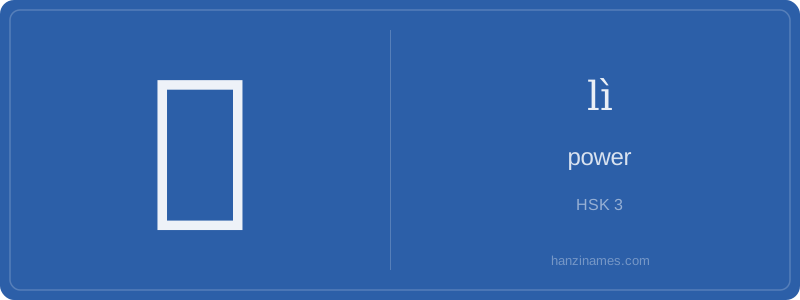
力 is ubiquitous in modern Chinese: from classroom posters urging 学习要用力 (xuéxí yào yòng lì, 'study diligently') to fitness apps tracking daily 'effort points'. It appears in foundational idioms like 尽力而为 (jìnlì ér wéi, 'do one’s utmost') and the national motto 自力更生 (zìlì gēngshēng, 'self-reliance'), promoted since the 1950s to emphasize domestic industrial capacity during embargoes.
Archaeologically, 力 first appears in Shang dynasty oracle bone inscriptions (c. 1200 BCE) as a pictograph resembling a bent arm holding a plough or lever—documented in the *Jiǎgǔwén Biān* (Oracle Bone Script Compilation). Its two-stroke form stabilized by the Qin dynasty, preserving the essence of muscular exertion and mechanical advantage.
The character 力 (lì) embodies more than brute strength—it reflects the Chinese philosophical understanding of power as dynamic, relational, and ethically grounded. In classical thought, true ‘power’ arises not from domination but from alignment with natural order (道, dào) and moral integrity (德, dé). This is why 力 appears in terms like 力行 (lìxíng, 'to earnestly practice virtue')—power activated through ethical action, not coercion.
Historically, 力 was central to statecraft and self-cultivation alike. The Confucian ideal of the junzi (gentleman) required ‘inner power’—resilience, perseverance, and quiet influence—rather than loud authority. Daoist texts likewise praise soft, yielding 力 that bends without breaking, echoing water’s persistent force. Thus, 力 is never neutral: it gains meaning only through its moral and contextual framing.
This worldview contrasts sharply with Western conceptions of power as control or resource. In Chinese usage, 力 implies responsibility: one must have the strength *and* the wisdom to use it rightly. Even modern slogans like 为人民服务 (wèi rénmín fúwù, 'serve the people') presuppose that political power derives legitimacy from exerting 力 *for* collective well-being—not over it. Power, here, is a verb before it is a noun.
Example Sentences
Common Compounds
Similar Characters — Don't Mix These Up
Your First Step into Chinese Culture: Get a Chinese Name
Every journey into Chinese begins with a name. Use our free Chinese name generator to create a meaningful, personalized Chinese name that fits you perfectly.
Get My Chinese Name →