数
Character Story & Explanation
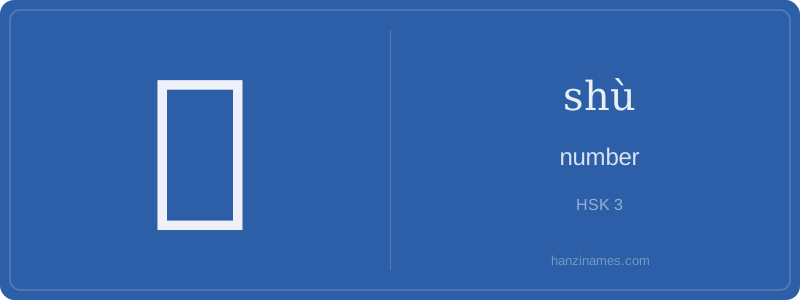
数 is ubiquitous in modern Chinese life: used daily in math education (HSK 3 learners encounter it in phrases like '数学'—mathematics), digital interfaces (e.g., '用户数'—user count), and official statistics (e.g., '人口数'—population figure). A well-documented idiom is 数一数二 (shǔ yī shǔ èr), meaning 'among the very best'—literally 'counting one, counting two', attested in Ming-Qing vernacular literature and still common in business and sports commentary.
The character’s earliest verified form appears in bronze inscriptions (c. 1000 BCE) as a compound of 攴 (a hand holding a stick, later simplified to 攵) and 數 (an older variant with 'silk threads' suggesting enumeration). By the Han dynasty, it standardized into today’s form—emphasizing deliberate, manual counting rather than abstract symbolism. No oracle-bone version survives; its documented origin centers on administrative record-keeping, not mystical divination.
The Chinese character 数 (shù) embodies the abstract yet foundational concept of 'number'—not merely as digits, but as quantified reality: statistics, rankings, quantities, and even philosophical notions of fate or destiny ('numerology' in folk belief). Unlike English's noun-verb distinction (e.g., 'number' vs. 'to number'), 数 flexibly serves as both noun and verb, reflecting Chinese’s grammatical economy. Its dual pronunciations—shù (noun: 'number') and shuò (adverb: 'frequently', as in 数见不鲜)—highlight how tone and context pivot meaning without changing form.
In Western thought, numbers often symbolize objectivity and universal logic—think Pythagoras’ 'all is number' or Descartes’ mathematical certainty. 数, however, carries embedded relationality: numbers in Chinese culture frequently signal harmony (e.g., auspicious 8), imbalance (inauspicious 4), or social hierarchy (e.g., 'the Three Numbers' in Confucian rites). This contrasts with Western numeracy’s emphasis on neutrality and measurement over moral or cosmological resonance.
While English uses separate roots for counting (count, calculate, enumerate), 数 unifies these under one grapheme—reinforced by its radical 攵 (‘step’ or ‘action’), historically denoting purposeful movement, like a scribe tallying. This visual link between action and abstraction mirrors how Chinese literacy treats numeracy as embodied practice—not just cognition. Thus, 数 is not passive data, but an active, culturally encoded lens: counting *is* interpreting, and numbers *mean* before they measure.
Example Sentences
Common Compounds
Similar Characters — Don't Mix These Up
Your First Step into Chinese Culture: Get a Chinese Name
Every journey into Chinese begins with a name. Use our free Chinese name generator to create a meaningful, personalized Chinese name that fits you perfectly.
Get My Chinese Name →