久
Character Story & Explanation
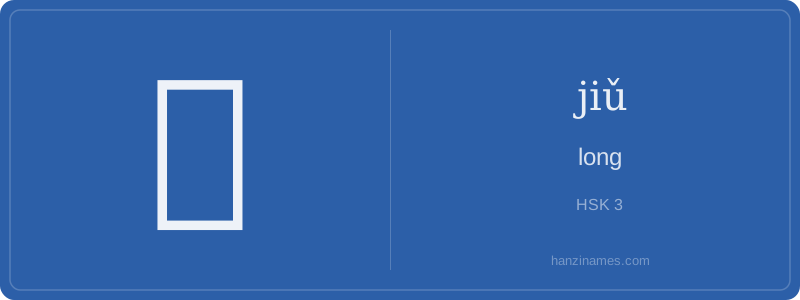
久 appears frequently in classical texts like the Analects and in modern Mandarin across contexts: greetings (久违了, jiǔ wéi le, 'Long time no see!'), formal expressions (久仰大名, jiǔ yǎng dà míng, 'I’ve long admired your reputation'), and compound words like 永久 (yǒngjiǔ, 'permanent'). It’s also central in idioms such as 天长地久 (tiān cháng dì jiǔ, 'as long as heaven and earth'), symbolizing eternal harmony between cosmos and humanity.
The earliest attested form of 久 appears in bronze inscriptions of the Western Zhou dynasty (c. 1046–771 BCE), where it resembles a stylized person kneeling with arms extended—a gesture of prolonged waiting or enduring submission. While its exact pictographic origin remains debated among paleographers, its consistent semantic core—'duration with intention'—has endured for over 2,700 years in documented usage.
The character 久 (jiǔ) embodies the Chinese philosophical appreciation of duration—not as mere chronology, but as meaningful continuity. In Confucian and Daoist thought, 'long' signifies endurance with virtue: a long reign implies benevolent rule; a long friendship reflects mutual sincerity; a long life is not just longevity but moral fulfillment. This relational understanding of time contrasts with Western linear, quantified time—here, 'long' gains value only when imbued with purpose, harmony, or loyalty.
Visually minimal yet conceptually deep, 久’s three strokes form an elegant asymmetry—no closed loops, no rigid symmetry—mirroring the Chinese view of time as flowing and adaptive, not mechanical or finite. Its radical 丿 (pie), often associated with movement or departure, suggests time as dynamic passage rather than static measurement. This subtle stroke choice reinforces how Chinese cosmology treats duration as lived experience, not abstract units.
In daily language, 久 activates relational depth: 久别重逢 (jiǔ bié chóng féng, 'long-separated, joyfully reunited') carries emotional weight far beyond 'long'; it evokes shared history, resilience, and renewal. Even in modern usage—like 久仰 (jiǔ yǎng, 'long admired', used humbly when meeting someone esteemed)—the character preserves a cultural grammar where time expresses respect, patience, and accumulated significance. To use 久 is to participate in this worldview.
Example Sentences
Common Compounds
Similar Characters — Don't Mix These Up
Your First Step into Chinese Culture: Get a Chinese Name
Every journey into Chinese begins with a name. Use our free Chinese name generator to create a meaningful, personalized Chinese name that fits you perfectly.
Get My Chinese Name →