包
Character Story & Explanation
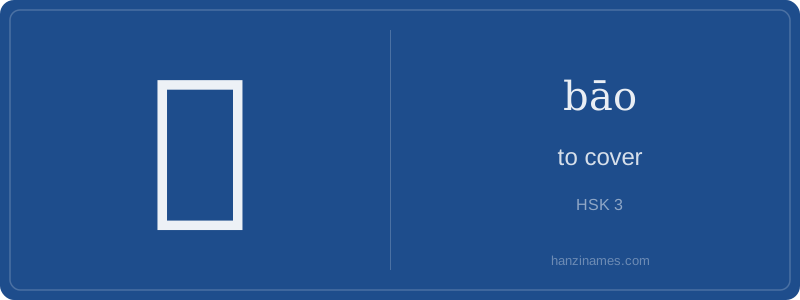
包 is ubiquitous in modern Mandarin: it appears in daily verbs like 包裹 (bāoguǒ, ‘to wrap/package’), nouns like 书包 (shūbāo, ‘schoolbag’), and idioms like 一包在身 (yī bāo zài shēn, ‘all essentials carried on one’s person’). Historically, the term 包办 (bāobàn, ‘to arrange everything’) gained prominence in 20th-century social discourse, describing arranged marriages—and later, state-managed welfare systems—highlighting its semantic extension into comprehensive responsibility.
The character’s earliest attested form appears in bronze inscriptions of the Western Zhou (c. 1046–771 BCE) as a pictograph of a person bending forward with arms encircling something—likely a child or bundle. By the Qin dynasty’s small seal script, it had standardized into the curved 勹 radical enclosing 巴, reflecting its core function: encompassing and securing.
The character 包 (bāo) embodies a foundational Chinese worldview: containment as care, not constraint. Its radical 勹—a curved enclosure—reflects the cultural reverence for protection, wholeness, and intentional boundary-making. In Confucian and Daoist thought, 'covering' implies nurturing what is precious within: a child in the womb, knowledge in a scroll, or harmony within a family. This isn’t suppression—it’s the quiet strength of holding space.
Unlike Western binaries of open/closed or freedom/control, 包 suggests dynamic inclusivity: to cover is to embrace, preserve, and prepare. A steamed baozi (包子) ‘covers’ filling with dough; a contract (包涵) ‘covers over’ a mistake with grace. The act of 包 carries moral weight—it implies responsibility for what lies within the fold, echoing the classical ideal of the junzi who ‘contains virtue without display’.
This worldview manifests in language, architecture, and ritual: ancestral tablets are kept in covered shrines; tea is steeped in lidded pots; even apologies use 包涵 (‘please cover/overlook my fault’). 包 teaches that true security arises not from exposure or dominance, but from mindful enclosure—where protection and respect coexist. It is the gentle curve of the arm around a loved one, rendered in ink: soft, deliberate, life-sustaining.
Example Sentences
Common Compounds
Similar Characters — Don't Mix These Up
Your First Step into Chinese Culture: Get a Chinese Name
Every journey into Chinese begins with a name. Use our free Chinese name generator to create a meaningful, personalized Chinese name that fits you perfectly.
Get My Chinese Name →