哭
Character Story & Explanation
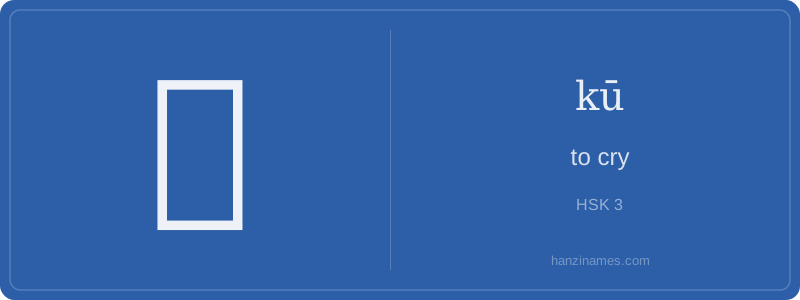
哭 is widely used in daily speech and writing, especially in emotional narratives, parenting contexts, and digital communication. It appears in fixed expressions like 哭笑不得 (kū xiào bù dé, 'neither laugh nor cry'—utter bewilderment) and the classical idiom 梨花带雨 (líhuā dài yǔ, 'pear blossoms with rain', describing tearful beauty). In historical records, the character appears in Han-dynasty bamboo slips and Tang poetry, consistently denoting vocal lamentation—not silent tears.
哭 is a phono-semantic compound: the upper part (now written as two 十-like strokes above 口) is a phonetic component derived from ancient forms of ‘ku’, while the lower 口 (mouth) is the semantic radical indicating sound production. Though its earliest oracle bone form is lost, bronze inscriptions from the Western Zhou show a mouth with droplets—confirming its core association with audible, tear-accompanied expression.
The Chinese character 哭 (kū) vividly conveys the act of crying—not just shedding tears, but expressing deep sorrow, grief, or even overwhelming joy through vocalized weeping. Unlike English ‘cry’, which can be neutral or even positive (e.g., ‘cry with laughter’), 哭 in standard usage emphasizes audible, emotionally charged weeping—often implying helplessness, loss, or intense distress. Its radical 口 (mouth) underscores the vocal component: this is not silent weeping, but wailing, sobbing, or lamenting aloud.
In contrast to Western cultural associations where crying may be framed as cathartic or psychologically healthy (e.g., ‘a good cry’), traditional Chinese discourse often views unrestrained 哭 as socially vulnerable—especially for men—and historically linked to ritual mourning. Classical texts like the *Book of Rites* prescribe regulated weeping during funerals, distinguishing proper lamentation (哭) from uncontrolled sobbing (号). Even today, phrases like ‘哭穷’ (kū qióng, ‘to plead poverty’) use 哭 metaphorically—not for emotion, but for strategic, performative expression.
Culturally, 哭 carries layered weight: it appears in Confucian ethics as a sign of filial sincerity (e.g., Mencius praises Duke Wen of Teng for weeping at his father’s death), yet modern urban usage often tones down its gravity—children ‘哭’ when scolded, adults ‘哭’ over dropped ice cream, and internet slang uses ‘哭死’ (kū sǐ, ‘I’m crying to death’) hyperbolically for relatable frustration. This duality—ritual solemnity versus everyday exaggeration—makes 哭 uniquely expressive across registers and eras.
Example Sentences
Common Compounds
Similar Characters — Don't Mix These Up
Your First Step into Chinese Culture: Get a Chinese Name
Every journey into Chinese begins with a name. Use our free Chinese name generator to create a meaningful, personalized Chinese name that fits you perfectly.
Get My Chinese Name →