啤
Character Story & Explanation
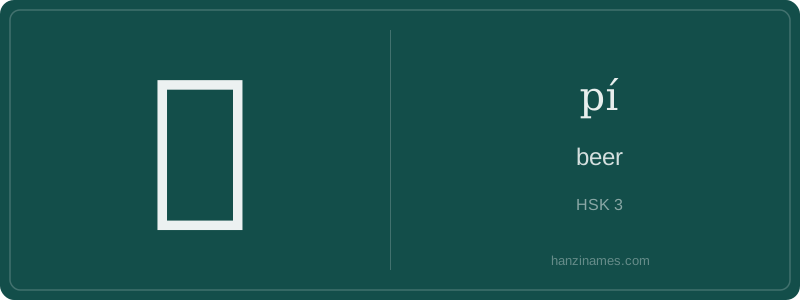
啤 appears almost exclusively in modern compound words—not standalone. It’s ubiquitous in daily life: 啤酒 (píjiǔ) ‘beer’ is HSK-3 vocabulary and appears on menus, ads, and beverage labels nationwide. The term dates to the Qing dynasty’s treaty-port era (1842–1912), with earliest verified print usage in 1897 Shanghai newspapers referring to German-imported lager. No classical idioms contain 啤; it’s absent from pre-20th-century texts.
The character has no ancient pictographic origin—it’s a modern phono-semantic compound created c. 1880–1890. Its right side ‘卑’ was chosen solely for pronunciation (bēi ≈ pí in rapid northern Mandarin speech), not meaning. Today, Chinese speakers use 啤 only in 啤酒 or loan blends like 啤酒屋 (píjiǔwū, ‘pub’)—never alone.
As an archaeologist sifting through layers of linguistic sediment, I uncover 啤 not in oracle bones or bronze inscriptions—but in the late 19th-century treaty ports of China. This character is a phonetic loan: its ‘mouth’ radical (口) signals it names something ingested, while the right-hand component ‘卑’ (bēi) was borrowed purely for its sound—approximating the foreign word 'beer'. No ancient Chinese brewed barley ale; 啤 is a lexical fossil of cross-cultural encounter, not indigenous invention.
The radical 口 here is no accident—it anchors 啤 in the domain of speech, taste, and consumption. In classical texts, 口 compounds often denote vocalizations (e.g., 听 tīng ‘to listen’) or ingestibles (e.g., 味 wèi ‘flavor’). 啤 thus linguistically ‘licenses’ beer as culturally legible: not as alien liquor, but as something spoken of, ordered, and drunk—integrated via script before it was fully domesticated in taste.
This character’s 11 strokes form a compact yet asymmetrical structure: three horizontal mouth strokes at the top, then the descending, slightly cramped ‘卑’, whose own etymology means ‘humble’ or ‘low’. Irony abounds—this ‘humble’ component now headlines a global commodity. Yet that humility reflects historical reality: 啤 entered Chinese not as imperial tribute, but as a modest import in Shanghai and Tianjin beer halls circa 1890s, later standardized in the 1950s by the PRC’s language reform committee.
Example Sentences
Common Compounds
Similar Characters — Don't Mix These Up
Your First Step into Chinese Culture: Get a Chinese Name
Every journey into Chinese begins with a name. Use our free Chinese name generator to create a meaningful, personalized Chinese name that fits you perfectly.
Get My Chinese Name →