境
Character Story & Explanation
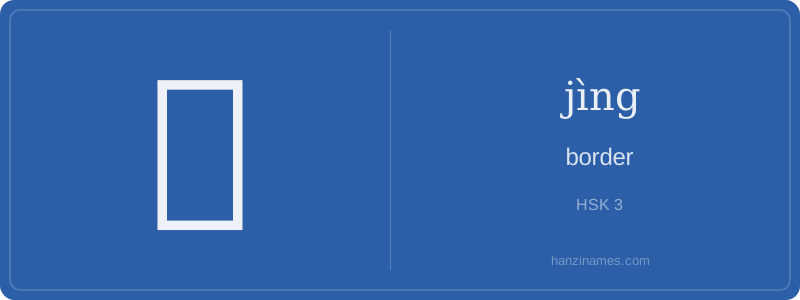
In modern Chinese, 境 is ubiquitous in formal and literary contexts — especially in compound words denoting scope, condition, or realm. It appears in official documents (e.g., 国境 guójìng, 'national border'), education (HSK 3 vocabulary), and idioms like 身临其境 (shēn lín qí jìng, 'to be right there in the scene'). Historically, the Tang dynasty poet Wang Wei used 境 in poetic theory to describe aesthetic 'artistic realms', cementing its cultural weight beyond geography.
The character’s form has no oracle-bone origins; it first appears in standardized Qin small seal script. Its left-side 土 radical signals earth-based domains, while 竟 (originally depicting a person wearing a ceremonial headdress, then evolving to mean 'completion') conveys finality — together, 'the end of the land'. Today, Chinese learners encounter it daily in phrases like 环境 (huánjìng, 'environment') — where 'border' metaphorically expands to 'surrounding conditions'.
As a linguistic detective, I begin with the character’s surface: 境 (jìng) — 14 strokes, radical 土 (earth/soil), clearly rooted in spatial and territorial concepts. The right side, 竟 (jìng), originally meant 'to finish' or 'end', suggesting a boundary where something concludes — like land ending at a frontier. This structural duality (earth + end) forms a semantic anchor: borders are not just lines on a map but grounded, physical limits.
Tracing its evolution through seal script (c. 3rd century BCE), 境 appears as a well-defined compound — no pictographic sun or river, but a deliberate fusion of 土 and 竟. Unlike ancient characters born from drawings of objects, 境 emerged as a conceptual synthesis during the Warring States period, when states urgently needed terms for jurisdiction and defended territory. Its earliest confirmed inscriptions appear on bronze ritual vessels and bamboo slips documenting land grants and border treaties.
By the Han dynasty, 境 had solidified its core meaning: a defined, administratively recognized boundary — whether geographic, political, or even metaphysical. It later extended into Buddhist texts (e.g., 佛境 fó jìng, 'Buddha-realm') to denote spiritual thresholds. This semantic expansion wasn’t mystical invention but logical extension: if a border marks where one domain ends and another begins, why not apply it to consciousness, art, or experience? The character’s durability lies in this precise yet flexible logic.
Example Sentences
Common Compounds
Similar Characters — Don't Mix These Up
Your First Step into Chinese Culture: Get a Chinese Name
Every journey into Chinese begins with a name. Use our free Chinese name generator to create a meaningful, personalized Chinese name that fits you perfectly.
Get My Chinese Name →