害
Character Story & Explanation
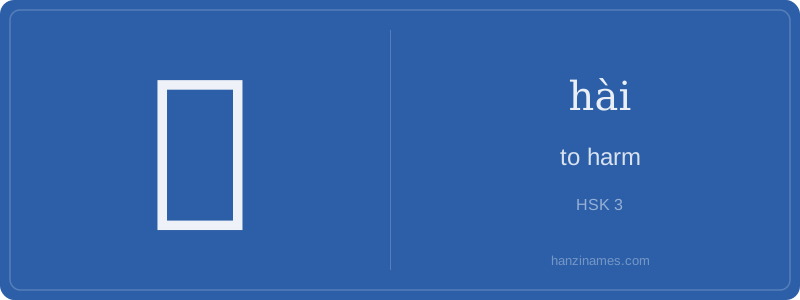
Historically, 害 appears in classical texts like the *Analects* (15.22): 'The gentleman fears harming virtue' (君子不害德), underscoring its moral dimension. In modern usage, it’s central to legal and public health discourse: 害虫 (hài chóng, 'pest'), 害处 (hài chu, 'harmful effect'), and the common warning phrase 小心有害 (xiǎo xīn yǒu hài, 'Caution: Harmful'). It’s also key in cybersecurity terms like 网络攻击有害 (wǎngluò gōngjī yǒu hài, 'cyberattacks are harmful').
The character’s form has no verified pictographic origin—it evolved from seal script, where the lower part resembles 止 (stop) under 宀 (roof), symbolizing 'stopping safety' or 'disrupting shelter'. No oracle bone form survives. Today, Chinese speakers use 害 most frequently in compound words (e.g., 害怕, 害羞) where it conveys psychological impact—fear or embarrassment—as internal harm.
As an archaeologist brushing dust from a Warring States bamboo slip, I find 害 inscribed with sharp, angular strokes—its 宀 (roof) radical sheltering a complex interior: 宀 + 害’s lower component, historically linked to 止 (to stop) and 口 (mouth), suggesting suppression or forced silence. This isn’t mere ‘harm’ as physical injury—it’s systemic: the silencing of voices, the undermining of stability beneath a roof—home, state, or moral order.
The character appears in early texts like the *Zuo Zhuan*, where rulers ‘harm virtue’ (害德) by breaking trust—not with swords, but with broken oaths. Its ten-stroke form stabilized by the Han dynasty, shedding earlier variants with doubled 口 or added 艮. The radical 宀 signals that harm originates *within* protected spaces: not wilderness, but courts, families, treaties—places where betrayal cuts deepest.
Excavating bronze inscriptions reveals 害 often paired with verbs of intention: 欲害 (intend to harm), 深害 (deeply harm), implying deliberation—not accident. Unlike passive suffering (苦), 害 is agentic: one *does* harm. This semantic gravity explains its HSK Level 3 placement: learners must grasp not just vocabulary, but ethical weight—the Chinese linguistic line between misfortune and moral failure.
Example Sentences
Common Compounds
Similar Characters — Don't Mix These Up
Your First Step into Chinese Culture: Get a Chinese Name
Every journey into Chinese begins with a name. Use our free Chinese name generator to create a meaningful, personalized Chinese name that fits you perfectly.
Get My Chinese Name →