层
Character Story & Explanation
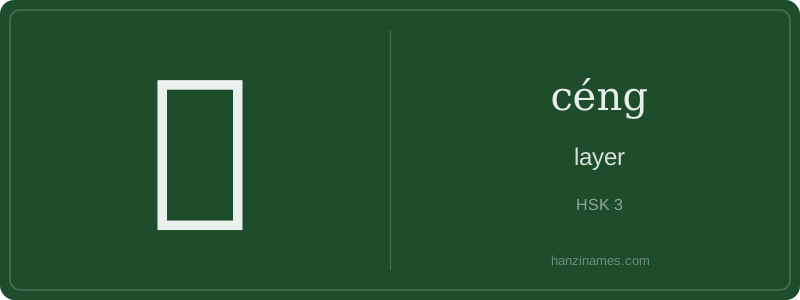
层 is ubiquitous in daily Chinese: people refer to apartment floors (三层, sān céng), organizational levels (管理层, guǎnlǐ céng), and social classes (社会阶层, shèhuì jiēcéng). It appears in the idiom ‘层出不穷’ (céng chū bù qióng), meaning ‘emerging endlessly like successive layers,’ used since at least the Song dynasty (10th–13th c.) to describe relentless innovation or recurring phenomena.
Graphically, 层 evolved from seal script where it combined 尸 (a simplified form of ‘person’/‘body’ acting as a structural frame) with 云 (yún, cloud) — later replaced by 曾 (zēng, indicating repetition and sequence). By the Han dynasty, the current form stabilized, emphasizing iterative, ordered succession rather than literal piling—reflecting how Chinese writing prioritizes functional logic over pictorial fidelity.
The character 层 (céng) embodies a foundational Chinese spatial and philosophical concept: layeredness—not as mere accumulation, but as intentional, hierarchical ordering. Unlike Western notions of linear progression, Chinese thought often sees reality as stratified—like bamboo joints, mountain terraces, or bureaucratic ranks—where each layer both rests upon and enables the next. This reflects Confucian respect for structured relationships and Daoist acceptance of natural gradation.
Historically, 层 appears in classical texts describing cosmic order: heaven’s layers (天层), poetic imagery of stacked clouds (云层), or layered governance (官层). Its radical 尸 (shī)—originally meaning ‘corpse’ but here functioning phonetically and structurally—anchors the character in the human body’s verticality: spine, ribs, and posture all imply stacking and support. This bodily resonance reinforces how deeply layered thinking is woven into lived experience.
In modern China, 层 remains indispensable for expressing social nuance: economic strata (阶层), educational tiers (年级层), or digital infrastructure (网络层级). Even AI models are described as ‘deep learning layers’ (深度学习层数). The character thus bridges ancient cosmology and contemporary tech—a quiet testament to how Chinese language preserves conceptual continuity across millennia through embodied, spatial metaphors.
Example Sentences
Common Compounds
Similar Characters — Don't Mix These Up
Your First Step into Chinese Culture: Get a Chinese Name
Every journey into Chinese begins with a name. Use our free Chinese name generator to create a meaningful, personalized Chinese name that fits you perfectly.
Get My Chinese Name →