己
Character Story & Explanation
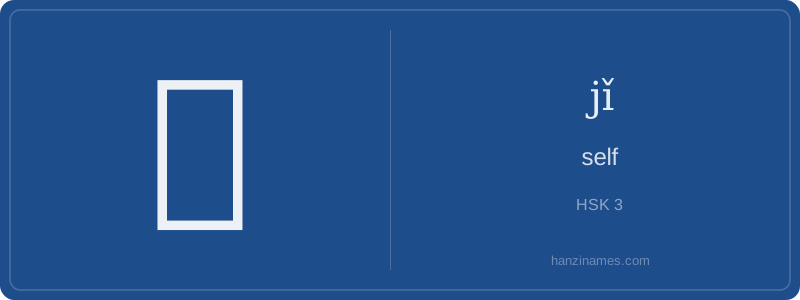
In daily modern Chinese, 己 is almost never used alone—it appears in fixed compounds expressing ethical self-reference: 克己 (kè jǐ, 'restrain oneself'), 悔己 (huǐ jǐ, 'regret one’s own actions'), and the classical idiom 己所不欲,勿施于人 (jǐ suǒ bù yù, wù shī yú rén) — Confucius’ ‘Do not impose on others what you do not desire for yourself.’ This phrase appears in the Analects (15.24) and remains quoted in education, politics, and ethics discourse across the Sinophone world.
The earliest attested form of 己 appears on Western Zhou bronze inscriptions (c. 1000 BCE) as a closed, asymmetrical loop—likely a simplified symbol derived from ritual vessel motifs, not a picture of the human body. Its form stabilized by the Qin dynasty standardization (3rd c. BCE), retaining its three-stroke structure. No oracle bone variant confirms a ‘serpent’ origin; scholarly consensus (per Karlgren, Qiu Xigui, and the *Chinese Etymological Dictionary*) treats it as an abstract signifier.
As an archaeologist brushing dust from a Warring States bamboo slip, I find 己 etched with startling consistency—not as a pictograph of a coiled serpent (a long-debunked myth), but as a stylized loop, likely abstracted from early ritual vessel markings. Its three strokes—downward curve, upward hook, final horizontal sweep—reveal a scribe’s economy: minimal lines for maximal conceptual weight. This wasn’t a depiction of the body, but a glyph that anchored identity in written form long before standardized dictionaries.
Excavations at Guodian and Mawangdui confirm 己 appears over 200 times in pre-Qin philosophical texts—not as a standalone noun, but as a bound morpheme in ethical constructs like 克己 (kè jǐ, 'restrain oneself'). The character rarely stands alone in ancient inscriptions; instead, it functions as a grammatical keystone, marking reflexive agency. Its stability across centuries suggests it encoded not ego, but disciplined selfhood—a concept central to Confucian self-cultivation.
Unlike characters born from nature imagery (e.g., 日 ‘sun’ or 木 ‘tree’), 己 evolved through calligraphic streamlining, not pictorial fidelity. Oracle bone and bronze script forms show variant loops and hooks, yet the core closed shape persists. This continuity hints at its functional primacy: a visual shorthand for interiority in a logographic system where meaning relies on relational context. Its survival isn’t due to iconic clarity—but because it solved a linguistic need: naming the subject of moral action without ambiguity.
Example Sentences
Common Compounds
Similar Characters — Don't Mix These Up
Your First Step into Chinese Culture: Get a Chinese Name
Every journey into Chinese begins with a name. Use our free Chinese name generator to create a meaningful, personalized Chinese name that fits you perfectly.
Get My Chinese Name →