张
Character Story & Explanation
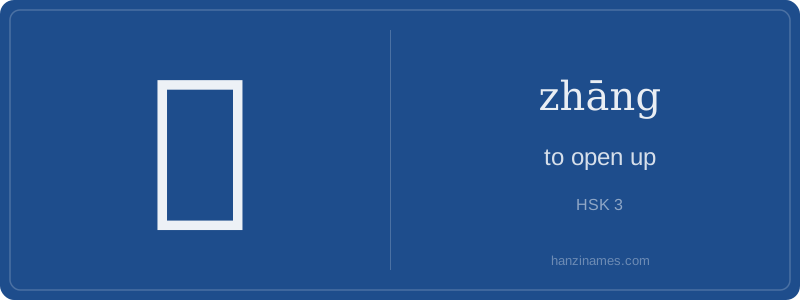
张 is one of the top 10 most common surnames in China — over 100 million people bear it, historically linked to the ancient Zhangguo State and the Yellow Emperor’s archer, Zhang Hui. As a verb, it appears in standard phrases like 张开嘴 (zhāngkāi zuǐ, 'open one’s mouth') and idioms such as 东张西望 (dōng zhāng xī wàng, 'look around distractedly'). It's also the measure word for flat, thin objects — e.g., 一张纸 (yī zhāng zhǐ, 'one sheet of paper') — codified in the 1956 Chinese Character Reform.
The character evolved from seal script, where 张 clearly depicted a bow (弓) being drawn by a hand (later stylized as 长). Archaeological inscriptions from the Warring States period (475–221 BCE) show early forms emphasizing tension and extension — confirming its core meaning of 'opening/stretching' rather than mere 'spreading'.
Hi students! Let’s learn 张 (zhāng), a very common character at HSK Level 3. It has 7 strokes and belongs to the 弓 (gōng) radical — meaning 'bow', which hints at its original idea of stretching or opening something taut, like drawing a bowstring. Though its basic dictionary meaning is 'to open up', it’s rarely used alone in modern speech — instead, it appears in dozens of essential words like 张开 (zhāngkāi, 'to open'), 一张 (yī zhāng, 'one sheet') and even as a surname (Zhang).
Don’t confuse 张 with other characters that look similar — its left side is clearly the bow radical (弓), not 工 (gōng, 'work') or 弟 (dì, 'younger brother'). The right side is 长 (cháng/zhǎng), meaning 'long' or 'to grow', reinforcing the idea of extension or expansion. This combination makes sense: drawing a bow *stretches* it open — a vivid, physical image behind an abstract verb.
As you practice writing 张, remember the stroke order: start with the bow (three strokes: horizontal, left-falling, then hook), then write the 'long' component (four strokes). Saying 'zhāng' aloud helps too — it’s first tone, clear and level, like holding a note steadily. In daily life, you’ll hear it constantly: when ordering food ('a plate of dumplings'), describing facial expressions ('eyes wide open'), or counting paper items ('one sheet of paper'). Mastering 张 unlocks real communication!
Example Sentences
Common Compounds
Similar Characters — Don't Mix These Up
Your First Step into Chinese Culture: Get a Chinese Name
Every journey into Chinese begins with a name. Use our free Chinese name generator to create a meaningful, personalized Chinese name that fits you perfectly.
Get My Chinese Name →