必
Character Story & Explanation
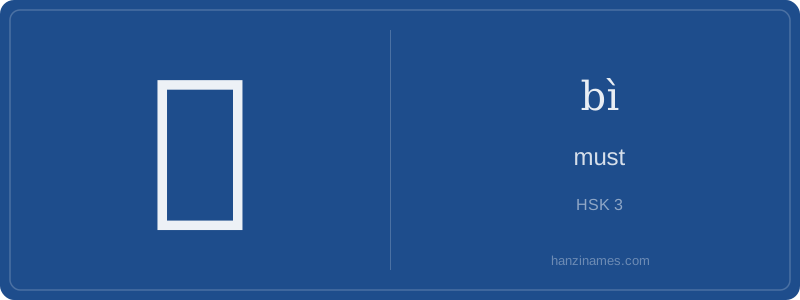
必 is ubiquitous in modern Standard Chinese: it appears in official documents, public notices, textbooks, and news headlines—especially in mandatory phrases like 必须 (bìxū, 'must') and 必然 (bìrán, 'inevitable'). A well-documented usage is in the PRC’s Compulsory Education Law, which states that '适龄儿童必须接受义务教育' ('School-age children must receive compulsory education'). It also features in the idiom 事半功倍,必有其因 (a variation emphasizing causal certainty), though more commonly appears in set phrases like 有备无患,有备必胜 ('Be prepared, and victory is certain').
The earliest attested form of 必 appears in Warring States bamboo slips (4th c. BCE), where it already functions as a modal adverb meaning 'necessarily'. Its structure—originally interpreted as 'three strokes above heart'—was standardized by the Han dynasty. Scholars agree it’s not pictographic; rather, it evolved from a phonetic loan character with no concrete object reference, so we focus on its enduring real-world function: signaling non-negotiable requirement.
Hello students! Today we’ll explore the character 必 (bì), meaning 'certainly' or 'must'. Though it looks simple—just five strokes—it carries strong modal force in Chinese grammar. It’s not just a word for emphasis; it expresses logical necessity, obligation, or inevitability—like saying 'there’s no way around it'. You’ll find it in formal speech, written instructions, and exam questions. It never stands alone as a sentence word; instead, it always modifies a verb or adjective, making the action unavoidable.
Notice its radical is 心 (xīn), meaning 'heart'—but don’t be misled! This is a *semantic-phonetic compound*, where the bottom part (八) hints at pronunciation (bā → bì via historical sound shift), and the top (丿 + 丶) plus 心 evolved into today’s form. Modern learners shouldn’t read ‘heart’ literally here—it’s a structural remnant, not a meaning clue. Think of 必 as a grammatical anchor, not an emotional one.
At HSK Level 3, 必 appears frequently in expressions like 必须 (bìxū, 'must') and 必然 (bìrán, 'inevitable'). Unlike English ‘must’, which can be softened ('I must try'), 必 almost always signals objective, external necessity—not personal desire. That’s why you’ll see it in laws, safety signs ('必须戴口罩' — 'Face masks must be worn'), and academic writing. Mastering 必 helps you sound precise, authoritative, and native-like in serious contexts.
Example Sentences
Common Compounds
Similar Characters — Don't Mix These Up
Your First Step into Chinese Culture: Get a Chinese Name
Every journey into Chinese begins with a name. Use our free Chinese name generator to create a meaningful, personalized Chinese name that fits you perfectly.
Get My Chinese Name →