提
Character Story & Explanation
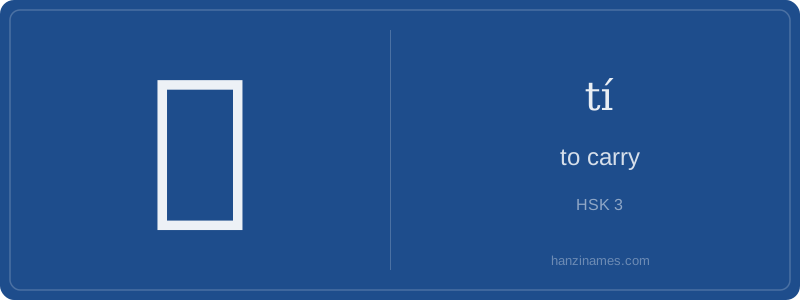
提 is ubiquitous in modern Mandarin: students ‘raise a question’ (提问), officials ‘submit a proposal’ (提案), and shoppers ‘pick up’ parcels (取提). It appears in the official name of China’s State Council (国务院), whose departments issue 提案 (tíchǎn, formal proposals). Historically, during the Ming and Qing dynasties, 提督 (tídū) was a high-ranking military title — literally ‘one who lifts and supervises’, reflecting command authority over regional forces.
The character’s form has no verified oracle-bone origin. Its earliest secure attestation is in Warring States bamboo slips (475–221 BCE), where it consistently combines 扌 (hand action) and 是 (sound cue). Rather than imagining ancient pictographs, picture today’s courier scanning a QR code and saying, ‘Your package is ready for pickup’ — that ‘pickup’ is 提 in action: concrete, immediate, and essential.
Our detective begins at the crime scene: the character 提. At first glance, it’s a hand (扌) gripping something — but not just any object. The right side, 是, isn’t a random decoration; it’s a phonetic component borrowed for its sound (shì → tí), a classic case of phono-semantic compounding common in later seal and clerical scripts. This tells us 提 wasn’t born as a pictograph but engineered — a linguistic ‘composite suspect’ designed for clarity and consistency.
Zooming in on the hand radical 扌, we see a clear functional fingerprint: every verb with this radical involves manual action — lift, hold, push, pull. 提 inherits that physicality. Though modern usage leans abstract (‘raise a question’, ‘propose an idea’), its core remains tactile: lifting something *upward*, whether a bucket, a topic, or a proposal. That upward motion is encoded in both form and function.
The evolution isn’t mystical — it’s bureaucratic. By the Han dynasty, 提 appears in administrative texts meaning ‘to submit’ or ‘to present documents’. Over centuries, the concrete act of *carrying up* (e.g., carrying tribute to a superior) metaphorically extended to *bringing forward* ideas, concerns, or requests. So 提 didn’t drift from ‘carry’ to ‘propose’ — it carried that meaning upward, step by semantic step.
Example Sentences
Common Compounds
Similar Characters — Don't Mix These Up
Your First Step into Chinese Culture: Get a Chinese Name
Every journey into Chinese begins with a name. Use our free Chinese name generator to create a meaningful, personalized Chinese name that fits you perfectly.
Get My Chinese Name →