担
Character Story & Explanation
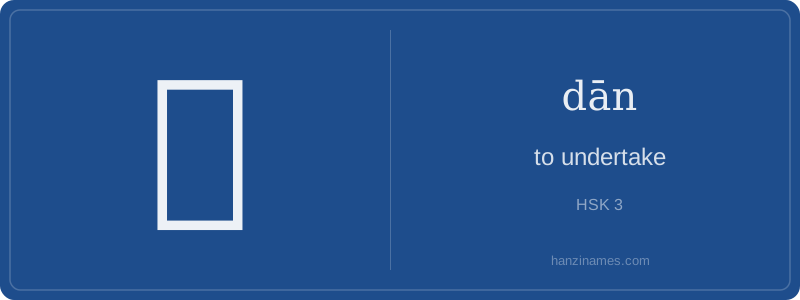
担 is deeply embedded in modern Chinese usage — especially in expressions of duty and resilience. You’ll hear it daily in phrases like 担任 (dānrèn, 'to serve as') and 担心 (dānxīn, 'to worry'), both HSK 4+ vocabulary. A well-documented idiom is ‘一人做事一人当’ (yī rén zuò shì yī rén dāng, 'one person does it, one person bears it') — emphasizing personal accountability, a core cultural value. Government slogans and news reports frequently use 担 when discussing leadership responsibility (e.g., 领导干部要勇于担当).
The character’s earliest verified form appears in seal script (c. 3rd century BCE), combining 扌 (hand/action) and 旦 (dàn, 'dawn', used here for sound). Though not a pictograph, its structure reflects how ancient Chinese conceptualized responsibility: physically lifting — like bearing a load at daybreak, symbolizing readiness and duty. Today, Chinese people still say 我来担吧 ('Let me take this on') to volunteer for tough tasks — real, warm, and culturally resonant.
Hi students! The character 担 (dān) is a very practical and commonly used verb meaning 'to undertake', 'to bear', or 'to take on responsibility'. It appears early in your learning journey — it’s HSK Level 3 — so you’ll see it in everyday contexts like work, family duties, or social expectations. Think of it as the Chinese way to say 'I’ll handle it!' or 'She carries the burden.' Its left-hand radical 扌 (hand) tells us it’s an action involving physical or metaphorical lifting — just like carrying a load on your shoulders.
The character has two main pronunciations: dān (most common, verbal meaning) and dàn (noun form, meaning 'a load' or 'a unit of weight'). This tone shift is typical in Chinese — same shape, different role! When you hear dān, it’s usually about taking responsibility; when you see dàn, it often refers to a literal or figurative load — for example, in historical texts, one dàn equals about 50 kg. Mastering this duality helps you understand both grammar and culture.
Don’t confuse 担 with similar-looking characters like 胆 (dǎn, 'gallbladder/courage') or 但 (dàn, 'but'). The hand radical (扌) is your anchor: if it’s on the left and means action, it’s likely 担. Practice writing it with its 8 strokes — start with the three-stroke hand radical, then add the right-side component 旦 (dàn), which originally meant 'dawn' but here serves as a phonetic hint. Writing it slowly builds muscle memory and meaning connection!
Example Sentences
Common Compounds
Similar Characters — Don't Mix These Up
Your First Step into Chinese Culture: Get a Chinese Name
Every journey into Chinese begins with a name. Use our free Chinese name generator to create a meaningful, personalized Chinese name that fits you perfectly.
Get My Chinese Name →