板
Character Story & Explanation
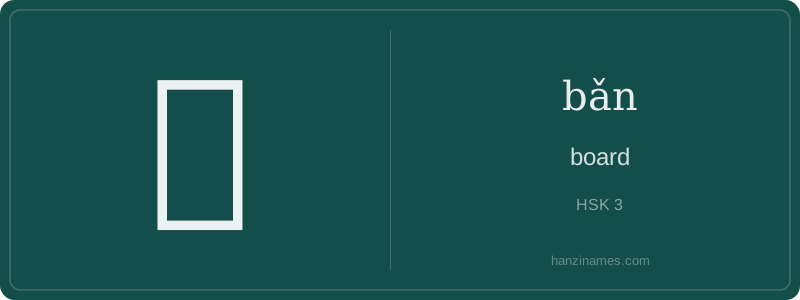
Historically, 板 referred literally to flat wooden planks used in construction, writing tablets (bamboo or wooden slips), and official documents — hence phrases like 奏板 (zòubǎn, 'imperial memorial tablet') in imperial records. Today, it’s ubiquitous: students erase the 黑板 (hēibǎn), engineers design 电路板 (diànlùbǎn), and teachers scold 'Don’t be so 死板!' Meaning 'rigid', this usage is documented in modern standard dictionaries like the Xiandai Hanyu Cidian. The character also appears in the idiom 板上钉钉 (bǎn shàng dìng dīng, 'nail on a board') — meaning 'settled beyond doubt', reflecting its association with solidity and permanence.
The character 板 first appeared in seal script (c. 3rd century BCE) as a clear picto-phonetic compound: 木 indicated material origin (wood), while 反 (originally pronounced closer to *bǎn* in Old Chinese) provided sound. No oracle bone form survives, but bronze inscriptions confirm its early use for wooden slats and administrative tablets — verified by archaeological finds from Warring States bamboo manuscripts.
Hi students! Let’s explore 板 (bǎn), a Level 3 HSK character meaning 'board' — like a wooden plank, a blackboard, or even a stiff facial expression. It’s built from the 木 (mù, 'tree') radical on the left, showing its original connection to wood, and 反 (fǎn, 'to turn over') on the right, which here serves mainly as a phonetic hint (though pronunciation has shifted over time). This is a great example of a semantic-phonetic compound — one of the most common character types in Chinese.
Don’t confuse 板 with similar-looking characters! Its eight strokes are clean and structured: start with the wood radical (four strokes), then write 反 carefully — remember the dot comes before the horizontal stroke in the top-right corner. Practicing stroke order helps your handwriting look natural and improves memory — try tracing it slowly while saying 'bǎn' aloud each time.
板 appears in many everyday words — from classroom tools (黑板 hēibǎn, 'blackboard') to tech (电路板 diànlùbǎn, 'circuit board') and even idioms like 死板 (sǐbǎn, 'rigid'). Interestingly, when used to describe people, 板 often implies stiffness — not just physically ('stiff board'), but behaviorally ('unflexible', 'by-the-book'). This metaphorical extension shows how deeply material objects shape Chinese language and thought.
Example Sentences
Common Compounds
Similar Characters — Don't Mix These Up
Your First Step into Chinese Culture: Get a Chinese Name
Every journey into Chinese begins with a name. Use our free Chinese name generator to create a meaningful, personalized Chinese name that fits you perfectly.
Get My Chinese Name →