极
Character Story & Explanation
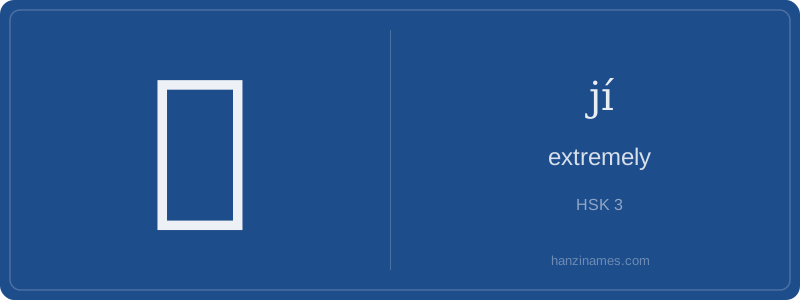
Today, 极 appears ubiquitously in standardized Chinese: in HSK 3 textbooks as an adverb meaning 'extremely' (e.g., 极其重要), in official documents (e.g., 极限载重 — 'maximum load capacity'), and in six common idioms including 登峰造极 and 物极必反 ('things revert when pushed to the extreme', from the Dao De Jing). It’s also embedded in technical terms like 极地 (polar regions) and 极光 (aurora), reflecting its enduring association with geographical and atmospheric extremes.
The character’s form is not pictographic but phono-semantic: 木 (mù, 'tree') serves as the semantic component—historically signaling upright position or structural support—while 及 (jí, 'to reach') provides phonetic guidance. No oracle bone or bronze inscription shows 极; it first appears reliably in Warring States bamboo texts (c. 475–221 BCE) as a compound marker of culmination.
As an archaeologist brushing dust from a Han dynasty bamboo slip, I find 极 inscribed in clerical script—not as a standalone word, but as the apex of cosmic order: the North Star, the celestial pole. Early texts like the Book of Rites use it to denote the ultimate point of reference in heaven and earth—where all directions converge. Its radical 木 (tree) hints not at wood, but at verticality: an ancient cosmological axis, like a sacred pillar linking realms.
This character was never merely ‘extreme’ in a modern emotional sense—it encoded precision in measurement and authority in governance. In imperial star charts, 极 marked the unmoving pivot around which the heavens rotated; in legal codes, 极刑 meant ‘supreme penalty’, reserved for treason. Its semantic weight carried the gravity of finality, not exaggeration—a distinction lost in casual modern usage.
Over centuries, its meaning softened through colloquial erosion: from ‘cosmic pole’ to ‘utmost degree’, then to emphatic intensifier. Yet traces remain—in bureaucratic terms like 极端主义 (extremism), where ‘pole’ still implies ideological rigidity, and in poetic compounds like 登峰造极 (to reach the summit and forge the pole), echoing its original spatial and metaphysical centrality.
Example Sentences
Common Compounds
Similar Characters — Don't Mix These Up
Your First Step into Chinese Culture: Get a Chinese Name
Every journey into Chinese begins with a name. Use our free Chinese name generator to create a meaningful, personalized Chinese name that fits you perfectly.
Get My Chinese Name →