河
Character Story & Explanation
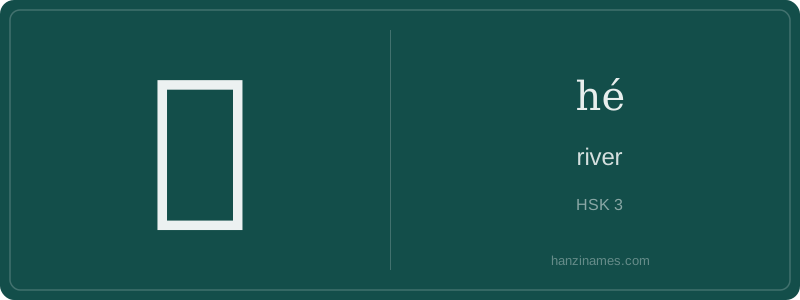
河 is ubiquitous in Chinese geography, administration, and daily speech: the Yellow River (黄河 Huáng Hé) and Yangtze River (长江 Cháng Jiāng, though 长 not 河, often paired contextually) anchor China’s civilizational narrative. It appears in place names (Hebei 河北 ‘north of the river’), idioms like ‘气壮山河’ (qì zhuàng shān hé, ‘spirit fills mountains and rivers’), and environmental discourse (e.g., ‘治理河流’ zhìlǐ héliú, ‘govern rivers’). Historically, the term appears in the Classic of Poetry (Shījīng, c. 11th–7th c. BCE) referring to the Yellow River.
The character’s origin is documented: in bronze inscriptions (c. 12th–3rd c. BCE), 河 combined 水 (water) with 可 as phonetic—later simplified to the modern three-dot water radical 氵. No oracle bone form survives, but Shuōwén Jiězì (121 CE) explicitly classifies it as a phono-semantic compound with 水 as meaning and 可 as sound.
Our detective work begins with the radical 氵—three water dots, a classic 'water' indicator in Chinese characters. This radical appears on the left side of 河, instantly signaling its connection to liquid, flow, or bodies of water. In ancient scripts like seal script (c. 3rd century BCE), the character already featured this water radical paired with a phonetic component, showing early standardization of semantic-phonetic structure.
The right-hand component, 可 (kě), originally served as a phonetic clue—though modern pronunciation hé diverges slightly from kě, this reflects predictable sound shifts over two millennia. Historical phonology records show Middle Chinese *ɦɑ* for 河, aligning closely with older pronunciations of 可. Such phonetic borrowing is common in Chinese character formation and underscores how sound and meaning were deliberately layered.
Unlike purely pictographic characters (e.g., 日 ‘sun’), 河 never depicted a river visually. Instead, it exemplifies the phono-semantic compound type—80% of modern Chinese characters—which combines meaning (water) and approximate sound (可). Its stroke count (8) reflects efficient design: three dots + five strokes for 可. This balance of clarity, economy, and systematic logic made 河 stable across script reforms, surviving unchanged from Han dynasty clerical script to today’s standard form.
Example Sentences
Common Compounds
Similar Characters — Don't Mix These Up
Your First Step into Chinese Culture: Get a Chinese Name
Every journey into Chinese begins with a name. Use our free Chinese name generator to create a meaningful, personalized Chinese name that fits you perfectly.
Get My Chinese Name →