照
Character Story & Explanation
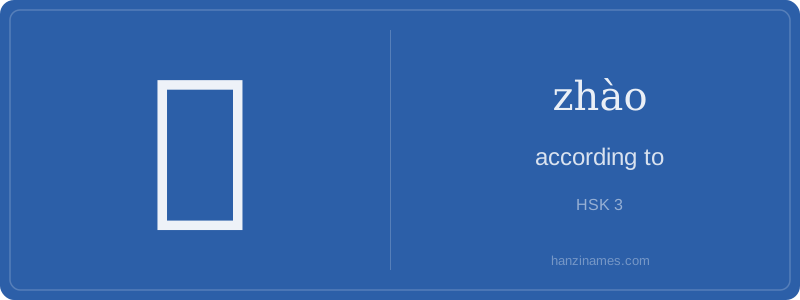
照 is widely used in modern Chinese for directives, compliance, and procedural language: signs in public institutions read 照章办事 ('handle matters according to regulations'), and students hear 照老师说的做 ('do as the teacher said'). The idiom 照本宣科 ('read verbatim from the textbook') criticizes rote teaching—highlighting how deeply embedded 照 is in education and bureaucracy. Historically, it appears in Ming and Qing legal texts emphasizing adherence to statutes.
The character evolved from 少 + 灬 (fire radical), but its modern form reflects phonetic-semantic compounding: the top part (召) suggests sound (zhào), while the bottom fire radical (灬) historically related to illumination—evoking the idea of 'shedding light on' or 'clarifying standards'. Though not pictographic today, its fire component subtly reinforces the notion of clarity and guidance in following rules.
The Chinese character 照 (zhào) is commonly taught at HSK Level 3 and carries the core meaning 'according to' or 'in accordance with', functioning primarily as a preposition. Unlike English prepositions like 'per' or 'as per', which are formal and often bureaucratic, 照 feels more versatile—used in everyday speech, instructions, and even legal or educational contexts. Its usage emphasizes fidelity to a standard, rule, or precedent, reflecting a cultural value placed on alignment with authority, tradition, or explicit guidelines.
While 'according to' in English often introduces sources ('according to the report'), 照 almost always governs a noun or noun phrase indicating a model, standard, or directive (e.g., 照规定 'according to regulations'). It rarely introduces people or documents directly—unlike English, where 'according to him' is common. This reflects a linguistic tendency in Chinese to foreground procedures and norms over individual voices in prescriptive contexts.
In Western equivalents, 'pursuant to' (legal), 'per' (military/technical), or 'as stipulated in' (formal contracts) come closest—but none match 照’s neutral tone and broad register range. A teacher might say 照课本做 ('do it according to the textbook') with gentle authority; a factory sign reads 照流程操作 ('operate according to procedure'). This pragmatic, action-oriented usage mirrors Confucian ideals of role-based conduct—doing things *as prescribed*, not merely *as someone says*.
Example Sentences
Common Compounds
Similar Characters — Don't Mix These Up
Your First Step into Chinese Culture: Get a Chinese Name
Every journey into Chinese begins with a name. Use our free Chinese name generator to create a meaningful, personalized Chinese name that fits you perfectly.
Get My Chinese Name →