熊
Character Story & Explanation
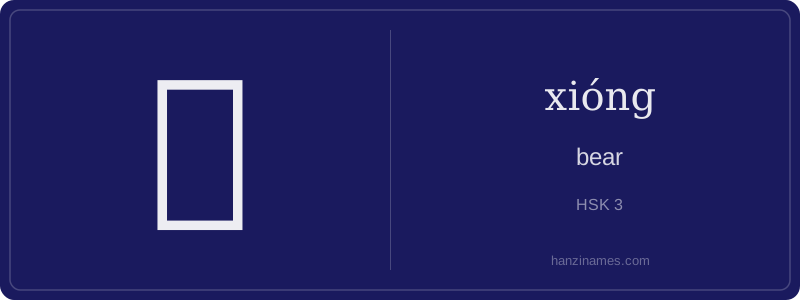
熊 appears in Classical Chinese texts like the *Shuōwén Jiězì* (121 CE), where it’s defined as a large, furry animal with claws—confirming its zoological basis. In daily life, it’s most commonly encountered in compound words: 大熊猫 (dà xióngmāo, giant panda), 熊猫 (xióngmāo, colloquial for panda), and idioms like 熊心豹子胆 (xióng xīn bào zi dǎn)—‘bear’s heart and leopard’s gall’, meaning reckless audacity. It also features in place names like Xiong’an New Area (雄安), though there homophone 雄 (xióng, 'heroic') is used instead.
The character’s form is not pictographic in oracle bone script (no verified early bear pictograph survives); instead, modern 熊 evolved from seal script variants combining 能 (néng, archaic 'bear', now meaning 'can/able') with the fire radical (灬) to emphasize its warm-blooded, vigorous nature—a documented semantic reinforcement, not invention.
The character 熊 (xióng) embodies more than zoology—it reflects how traditional Chinese thought intertwines animals with cosmic and moral symbolism. Unlike Western associations of bears with brute strength alone, classical texts link the bear to endurance, maternal protection, and even celestial order: the Big Dipper was historically called 北斗七星 (Běidǒu Qīxīng), but its shape evoked a bear’s posture in ancient star lore, reinforcing harmony between heaven and earth.
In Daoist and folk traditions, the bear symbolizes grounded vitality—its hibernation cycle mirroring yin-yang rhythms of rest and renewal. The character’s fire radical (灬) hints at inner warmth and transformative energy, not literal flame; this subtle layer shows how Chinese characters encode philosophical concepts through component logic rather than phonetic imitation.
Modern usage reveals cultural continuity and adaptation: while pandas (大熊猫) dominate global imagery, native brown bears once roamed northern China and appear in regional folklore from Heilongjiang to Sichuan. The character thus bridges ecological memory, linguistic structure, and evolving national identity—where ‘bear’ is both biological fact and cultural vessel carrying millennia of observation and reverence.
Example Sentences
Common Compounds
Similar Characters — Don't Mix These Up
Your First Step into Chinese Culture: Get a Chinese Name
Every journey into Chinese begins with a name. Use our free Chinese name generator to create a meaningful, personalized Chinese name that fits you perfectly.
Get My Chinese Name →