爷
Character Story & Explanation
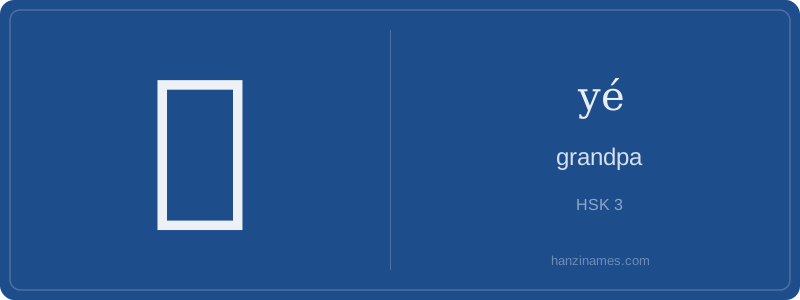
In modern Mandarin, 爷 is most commonly used in the reduplicated form 爷爷 (yéye) to mean 'paternal grandfather', though 爷 alone appears in affectionate or regional address (e.g., '爷爷' → '爷!'), historical titles ('王爷' wángyé, 'prince'), and Beijing slang ('小爷' xiǎoyé, 'young master'). It appears in idioms like 爷们儿 (yémenr), denoting traditional masculine virtue—documented in early 20th-century Beijing dialect studies and contemporary sociolinguistic surveys.
The character is not pictographic; its earliest attested form appears in Song-Yuan period vernacular texts as a simplified variant of 爺爺. Its structure combines the radical 父 (father) with a phonetic element that evolved graphically—no oracle bone or bronze script precursors exist. Today, Chinese children learn it in HSK 3 textbooks as part of family vocabulary, often writing it after mastering 父 and 也.
As an archaeologist brushing dust from a Ming-dynasty family register, I found 爷 etched beside ancestral portraits—not as a formal title, but as a tender, spoken abbreviation of 爺爺 (yéye), the intimate term for paternal grandfather. Its six strokes conceal no oracle-bone mystery; rather, it emerged in late imperial vernacular texts as a colloquial simplification, reflecting how kinship terms evolved in daily speech long before standardization.
This character’s radical 父 (fù, 'father') anchors it firmly in the patriarchal lineage system—yet its phonetic component 爺 is itself a reduplicated form, echoing oral tradition where repetition signals affection and familiarity. Unlike classical honorifics like 公 (gōng) or 翁 (wēng), 爷 carries warmth, informality, and regional flavor, especially in Northern Mandarin dialects where it’s used even for respected elders beyond blood relations.
Excavating Qing-era opera scripts and Beijing hutong memoirs, I observed 爷 functioning as both noun and vocative—addressing grandfathers, master craftsmen, or even fictional lords (e.g., 賈寶玉爺). Its semantic flexibility reveals a linguistic truth: respect in Chinese kinship isn’t rigidly hierarchical, but dynamically negotiated through tone, context, and repetition—making 爷 less a static ‘grandpa’ and more a living gesture of reverence wrapped in familiarity.
Example Sentences
Common Compounds
Similar Characters — Don't Mix These Up
Your First Step into Chinese Culture: Get a Chinese Name
Every journey into Chinese begins with a name. Use our free Chinese name generator to create a meaningful, personalized Chinese name that fits you perfectly.
Get My Chinese Name →