牙
Character Story & Explanation
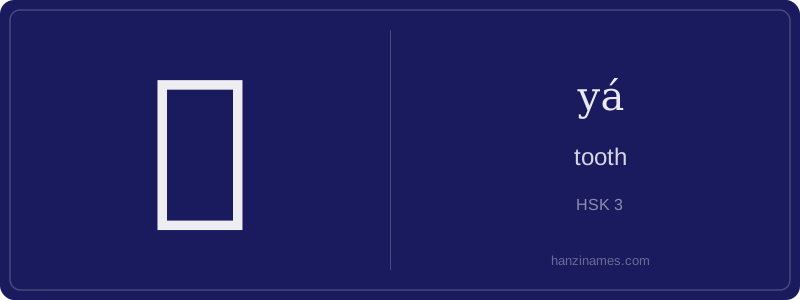
牙 is widely used in modern Mandarin in health, food, and commerce contexts: dentists’ clinics are marked 牙科 (yákē, 'dental department'), and phrases like '牙疼' (yáténg, 'toothache') appear in daily conversation and medical forms. It appears in the classical idiom '咬牙切齿' (yǎo yá qiè chǐ, 'gnashing one’s teeth in rage'), documented since at least the Song dynasty. The term '牙行' (yáháng, 'brokerage firm') reflects its historical role in trade — 'tooth' here metaphorically meant 'intermediary', referencing how brokers 'chewed over' deals.
Archaeological evidence shows 牙 evolved from a Bronze Age pictograph resembling two pointed teeth (⿱厶厶) — confirmed in early seal script inscriptions. By the Han dynasty, it standardized into today’s four-stroke form, retaining its dental meaning without semantic drift.
Hi students! The character 牙 (yá) means 'tooth' — simple and concrete. It’s one of the earliest Chinese characters still in use today, and it’s both a standalone word and a common component in compound words. Though it looks like a single unit, it’s actually an independent radical (no parent radical), which makes it special: it appears at the start of many dental or sharp-related terms. Don’t confuse it with mouth-related characters like 口 — 牙 specifically refers to teeth as hard, functional structures.
Phonetically, yá is a first-tone syllable — flat and high-pitched, like singing a clear 'yah!' Try holding your hand flat at shoulder height while saying it. Since it’s only four strokes, it’s easy to write once you learn the order: left diagonal, right diagonal, short horizontal, then the final hook-like stroke. This simplicity makes it a great anchor for learning more complex characters later.
At HSK Level 3, 牙 shows up in everyday vocabulary like 牙刷 (yáshuā, toothbrush) and 牙医 (yáyī, dentist). You’ll also see it in idioms and food terms — for example, 象牙 (xiàngyá, ivory) literally means 'elephant tooth'. Understanding 牙 helps you decode not just health terms but also cultural concepts tied to strength, precision, and even beauty (think of 'pearly whites' — 白牙 bái yá!).
Example Sentences
Common Compounds
Similar Characters — Don't Mix These Up
Your First Step into Chinese Culture: Get a Chinese Name
Every journey into Chinese begins with a name. Use our free Chinese name generator to create a meaningful, personalized Chinese name that fits you perfectly.
Get My Chinese Name →