留
Character Story & Explanation
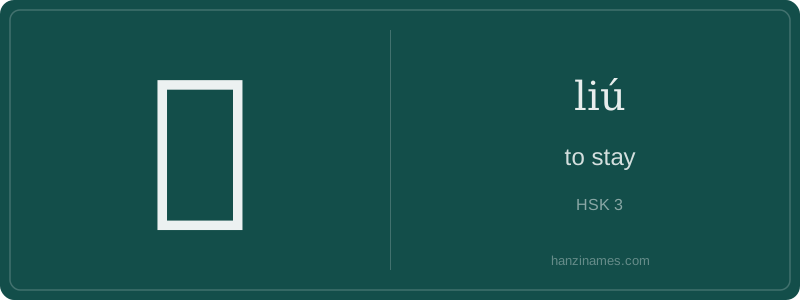
留 has been used consistently since the Han dynasty (206 BCE–220 CE) in official documents and poetry to mean ‘to retain’ or ‘to remain’. A well-documented modern usage is in the phrase 留守儿童 (liú shǒu ér tóng)—‘left-behind children’, referring to rural children whose parents migrate for work. This term appears in government reports and academic studies since the early 2000s. Another frequent collocation is 留言簿 (liú yán bù), a guestbook—still used physically in temples and digitally in apps like WeChat Moments.
The character’s seal script form shows a person () beside a field (田), suggesting ‘one who stays in the field’. While its exact oracle-bone origin is unattested, the small top component ( + 丶) likely represents a hand holding something still—a documented functional evolution in bronze inscriptions. Today, Chinese people use 留 daily when filling forms: ‘请留电话’ (Please leave your phone number).
Hi students! Today we’re learning 留 (liú), a Level 3 HSK character with 10 strokes and the 田 (field) radical. Don’t be misled by the English gloss ‘to leave’—it’s more precise to think of 留 as ‘to keep, retain, or cause to stay’. It implies intentional preservation: leaving something behind *on purpose*, like leaving a message, staying in a place, or keeping a souvenir. This is not the same as departing (which is 走 or 离开). Pay attention to context—it’s often used in formal or written Chinese, and rarely stands alone.
The character’s structure gives helpful clues: the top part (丶 + 厶 + 刀) evolved from an ancient form meaning ‘to halt’ or ‘to stop’, while the bottom 田 suggests stability—like something anchored in a field. So visually, it conveys ‘stopping something in place’. In speech, liú is always first tone—clear and level—never rising or falling. Practice saying it slowly: “lee-oh” (not “loo” or “lyoo”).
Remember that 留 is extremely common in compound words and grammar patterns. For example, 留下 (liú xià) means ‘to leave behind’, and 留学 (liú xué) means ‘to study abroad’—literally ‘stay to study’. It also appears in polite requests: ‘请您留下联系方式’ (Please leave your contact information). Think of it as the verb for *intentional retention*—whether physical objects, people, time, or even digital data (e.g., 留言 ‘leave a message’ on WeChat).
Example Sentences
Common Compounds
Similar Characters — Don't Mix These Up
Your First Step into Chinese Culture: Get a Chinese Name
Every journey into Chinese begins with a name. Use our free Chinese name generator to create a meaningful, personalized Chinese name that fits you perfectly.
Get My Chinese Name →