疼
Character Story & Explanation
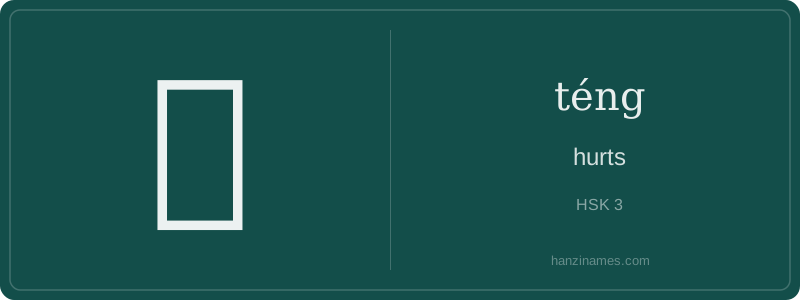
In daily life, 疼 is the go-to word for spontaneous, localized physical pain: children say ‘我的牙疼!’ (Wǒ de yá téng!) when a tooth aches; adults use it in clinics, pharmacies, and family conversations. It appears in the common phrase ‘头疼医头,脚疼医脚’ (tou téng yī tóu, jiǎo téng yī jiǎo)—a critique of symptom-only treatment, documented since the Ming dynasty in medical commentaries.
The character’s form is not pictographic but phono-semantic: 疒 (radical 104, ‘sickness’) signals meaning; the right side (originally 冫+冬, later standardized as +冫+冬) served as a phonetic hint for *téng*. No oracle bone or bronze inscription of 疼 survives—it first appears reliably in clerical script on Han bamboo slips, confirming its emergence during China’s classical medical codification.
As an archaeologist brushing dust from a Han dynasty medical bamboo slip, I found 疼 etched beside prescriptions for wind-cold ailments—proof it was already a living word for bodily pain over two millennia ago. Its radical 疒 (‘sickness’) anchors it firmly in the lexicon of illness and discomfort, while the phonetic component 冫+冬 (a variant form of ‘winter’ or ‘ice’) may subtly evoke the sharp, constricting sensation of sudden pain—like cold gripping the flesh.
This character does not depict a wound or blood, but rather the subjective experience: the inward flinch, the involuntary wince. Unlike clinical terms like 病 (illness) or 症 (symptom), 疼 names the raw, unfiltered feeling—the very first signal the body sends before diagnosis begins. Its early appearance in medical texts suggests ancient Chinese physicians prioritized patient-reported sensation as diagnostic evidence.
What makes 疼 remarkable is its semantic resilience: unchanged in core meaning for 2,000 years, yet fluid in usage—from describing a stubbed toe to expressing deep emotional ache (e.g., 心疼). It bridges somatic and affective realms without metaphorical stretching, revealing a linguistic worldview where physical and emotional pain share physiological grammar—a truth modern neuroscience now affirms.
Example Sentences
Common Compounds
Similar Characters — Don't Mix These Up
Your First Step into Chinese Culture: Get a Chinese Name
Every journey into Chinese begins with a name. Use our free Chinese name generator to create a meaningful, personalized Chinese name that fits you perfectly.
Get My Chinese Name →