总
Character Story & Explanation
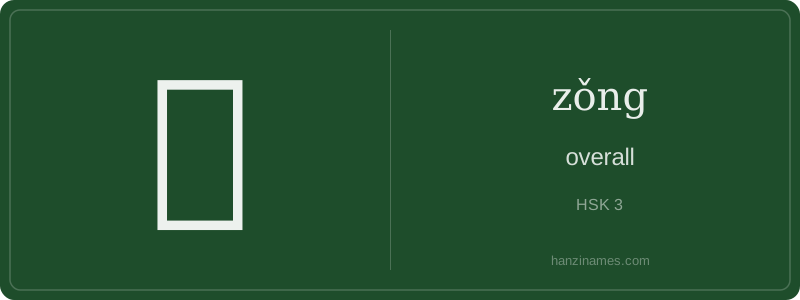
总 is ubiquitous in modern Chinese administration, education, and media. It anchors formal phrases like 总结 (zǒngjié, 'summary'), 总体 (zǒngtǐ, 'overall'), and the official title 国务院总理 (Guówùyuàn Zǒnglǐ, 'Premier of the State Council'). A well-documented idiom is 总而言之 (zǒng ér yán zhī), used since the Ming dynasty to introduce conclusions in essays and speeches—still required in HSK-3+ writing exams.
The character’s form evolved from seal script (c. 3rd century BCE), where it combined (duī, 'pile') above 心 (xīn, 'heart/mind')—visually representing 'mind synthesizing accumulated elements.' No oracle bone form exists; its earliest secure attestation is in Warring States bamboo texts, confirming its bureaucratic rather than ritual origin.
As an archaeologist brushing dust from a Han dynasty bamboo slip, I find 总 inscribed in clerical script—not as a cosmic symbol, but as administrative shorthand. Its earliest attested use (c. 2nd century BCE) appears in government documents meaning 'in sum' or 'collectively,' reflecting the imperial bureaucracy’s need to consolidate reports across commanderies. The character already carried semantic weight: not mere aggregation, but authoritative synthesis—what survives when details are stripped away.
Excavations at Juyan and Zhangjiashan confirm 总 was functional before philosophical abstraction: it labeled summary ledgers, tax tallies, and military rosters. Unlike poetic characters born of metaphor, 总 emerged from ink-stained desks—not oracle bones or bronze inscriptions. Its heart radical (心) signals cognitive synthesis, not emotion: the mind *processing* totality, not *feeling* wholeness. This pragmatic origin explains its later grammatical flexibility—as verb, noun, and adverb.
The Tang and Song dynasties reveal 总 evolving into linguistic scaffolding: prefixed to verbs (总说 zǒngshuō, 'to summarize'), adjectives (总之 zǒngzhī, 'in short'), and nouns (总统 zǒngtǒng, 'president'). Its semantic core remained stable—'the unifying principle behind multiplicity.' Even today, when a Chinese engineer says '总体方案' (zǒngtǐ fāng’àn), they echo the same impulse that moved Han scribes to tally grain shipments under one heading: reduce chaos to coherent whole.
Example Sentences
Common Compounds
Similar Characters — Don't Mix These Up
Your First Step into Chinese Culture: Get a Chinese Name
Every journey into Chinese begins with a name. Use our free Chinese name generator to create a meaningful, personalized Chinese name that fits you perfectly.
Get My Chinese Name →