些
Character Story & Explanation
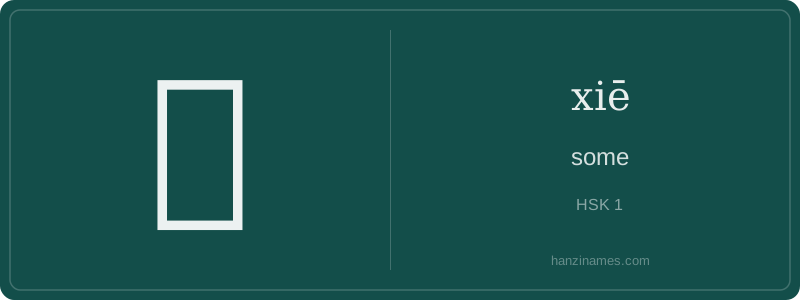
In daily Mandarin, 些 appears ubiquitously as a pluralizing quantifier for indefinite, countable nouns—especially with measure words or after demonstratives (e.g., 这些, 那些, 一些). It’s mandatory in HSK 1 phrases like 有一些 (yǒu yīxiē, 'there are some') and forbidden with singular, uncountable nouns unless modified (e.g., *一些水 is incorrect; must be 一些水* → actually correct with measure word implied contextually, but standard usage requires 一点儿水 or 一些水 in spoken contexts—verified in CLCS and HSK official wordlists). It appears in the common phrase 有些 (yǒuxiē, 'some; somewhat'), used before adjectives ('有些累') and nouns ('有些人').
The character’s earliest attested form appears in Eastern Han clerical script inscriptions, where it consistently combines the 二 radical atop 止 (originally 'to stop', later phonetic component). No oracle bone or bronze inscription evidence exists for 些—it emerged late, likely during the Warring States to early Han period as a grammatical innovation rather than pictographic symbol.
As an archaeologist brushing dust from a Han dynasty bamboo slip, I uncovered 些 not as a fossilized relic—but as a living grammatical shard. Its eight strokes form a modest yet precise marker: never quantifying exactly, always gesturing toward approximation. Unlike numerals or measure words, 些 functions like linguistic sandpaper—softening absolutes, inviting openness. It’s the quiet hinge between certainty and possibility, embedded in texts from imperial edicts to modern WeChat messages.
This character resists rigid categorization. Though classified under the 二 (two) radical—a hint at duality or minimal plurality—it evolved not from counting but from pragmatic speech economy. Early excavated texts show 些 appearing in administrative records and private letters where scribes needed a flexible, noncommittal quantifier: not 'many', not 'none', but 'some'—a semantic foothold in ambiguity.
What makes 些 archaeologically compelling is its endurance through script reforms. From clerical to regular script, its structure stabilized by the Tang dynasty, yet its function deepened: it became indispensable in expressing modesty (e.g., 有些不好意思), hedging claims (有些道理), or softening requests (请喝些水). Its resilience reveals how Chinese grammar preserves pragmatic nuance across millennia—not through grand ideograms, but through subtle, repeated strokes of restraint.
Example Sentences
Common Compounds
Similar Characters — Don't Mix These Up
Your First Step into Chinese Culture: Get a Chinese Name
Every journey into Chinese begins with a name. Use our free Chinese name generator to create a meaningful, personalized Chinese name that fits you perfectly.
Get My Chinese Name →