裙
Character Story & Explanation
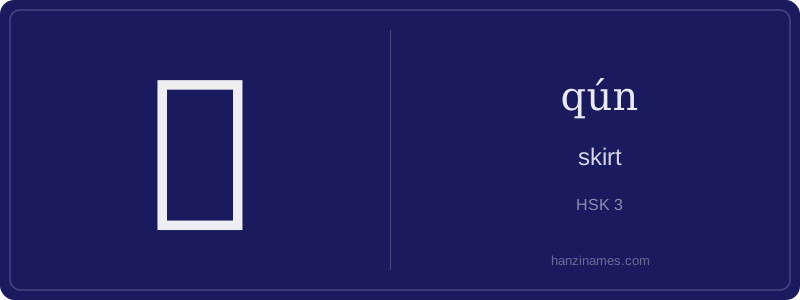
In contemporary China, 裙 appears ubiquitously: in e-commerce listings (e.g., Taobao’s top-selling ‘summer cotton qún’), school uniform policies (many junior high girls wear navy qún with blazers), and official documents—such as the 2021 Ministry of Education guidelines mentioning ‘appropriate qún length for physical education classes’. Common phrases include ‘穿裙子’ (to wear a skirt) and ‘裙子短了’ (the skirt is too short), often used in casual, descriptive speech. No widely attested idiom centers solely on 裙, but it features in compound terms like ‘裙带关系’ (guānxi built through family ties—literally ‘skirt-tie relationships’), a documented bureaucratic term dating to Ming-Qing administrative critiques.
The character 裙 first appeared in clerical script during the Han dynasty (206 BCE–220 CE), not earlier oracle bone inscriptions. Its form combines 衤 (clothing radical) + 君 (phonetic component, qūn → qún). There’s no pictographic origin—it’s a phono-semantic compound. Today, Chinese people most commonly use it while shopping online, trying on clothes in malls like Beijing’s Sanlitun, or discussing dress codes with teachers or employers.
Imagine strolling through Shanghai’s French Concession on a warm spring afternoon—sunlight glinting off vintage shop windows, the scent of osmanthus tea drifting from a nearby café. A young woman in a flowing qún—her high-waisted, pleated midi skirt in soft indigo linen—pauses to adjust her silk scarf. In China today, 裙 isn’t just clothing; it’s a quiet marker of personal expression, seasonal rhythm, and subtle cultural continuity—worn by students, office workers, and elders alike, especially during festivals or campus events.
The character 裙 belongs to the 衤 (clothing) radical family, anchoring it firmly in the semantic domain of apparel. Its 12 strokes combine structural clarity with graceful balance: the left side (衤) signals ‘garment’, while the right (君) serves phonetically, approximating the sound qún. Unlike ancient robes, modern qún are rarely ceremonial—but they carry layered meaning: modesty, elegance, and, increasingly, feminist reclamation of traditionally 'feminine' forms in urban fashion culture.
HSK Level 3 learners encounter 裙 early because it’s high-frequency, concrete, and culturally resonant—appearing in shopping dialogues, fashion blogs, and school uniforms. It’s also linguistically stable: no major historical shifts in meaning since at least the Tang dynasty, when ‘qún’ referred to wrap-around lower garments worn by both genders (though gendered usage solidified later). Mastery of 裙 opens doors to compound words like 百褶裙 (pleated skirt) and 连衣裙 (dress), making it a practical anchor in daily vocabulary.
Example Sentences
Common Compounds
Similar Characters — Don't Mix These Up
Your First Step into Chinese Culture: Get a Chinese Name
Every journey into Chinese begins with a name. Use our free Chinese name generator to create a meaningful, personalized Chinese name that fits you perfectly.
Get My Chinese Name →