越
Character Story & Explanation
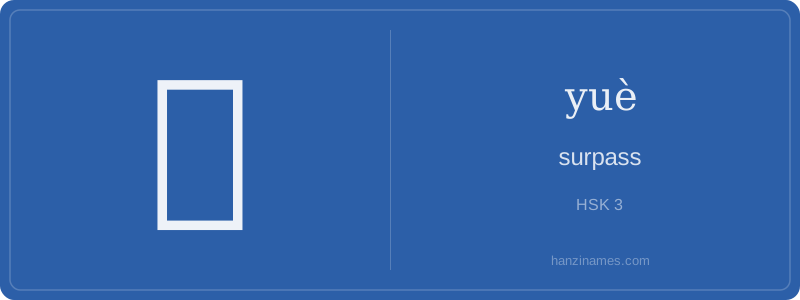
In historical usage, 越 appears prominently in dynastic records referring to southern polities: the State of Yue (Yuè Guó, 5th c. BCE) famed for King Goujian’s resilience; the Han-era Minyue and Nanyue kingdoms; and later, as a literary shorthand for Vietnam (e.g., 'Annam 越' in Ming-Qing documents). Modern Mandarin uses 越 primarily as a verb ('to surpass') or in compounds like 越南 (Yuènán, 'Vietnam'), preserving its ancient geographic resonance. It is central to idioms such as 越俎代庖 (yuèzǔdàipáo, 'to overstep one’s authority').
The character is not pictographic but phono-semantic: the left radical 走 (zǒu, 'to walk, move') signals motion-related meaning, while the right component 戉 (yuè, an ancient axe symbol) serves as a phonetic loan. Archaeological inscriptions (e.g., Warring States bamboo slips) confirm this structure predates the Qin unification, with no oracle bone form extant—its earliest secure attestation is on bronze vessels from the Spring and Autumn period.
The character 越 (yuè) opens a window into how traditional Chinese historiography conceptualized geographical and cultural frontiers. Rather than marking rigid borders, it signified dynamic zones of interaction—peoples and polities south of the Yangtze River and beyond, from the ancient Yue tribes of Zhejiang to the kingdoms of modern-day Vietnam and northern Laos. Its usage reflects a worldview where identity was relational: 'Yue' was defined not by fixed ethnicity but by position relative to the Central Plains—outside yet adjacent, distinct yet engaged in tribute, trade, and conflict.
This relational framing reveals a core feature of classical Chinese political thought: hierarchy without strict exclusion. The term appeared in early texts like the Records of the Grand Historian (Shǐjì), where Sima Qian documented states like Yue (越国) and Minyue (闽越) as semi-autonomous entities integrated into the imperial tributary system. Their inclusion in official histories affirmed their relevance—not as foreign 'others', but as integral, if peripheral, parts of the Sinocentric world order.
Over time, 越 evolved semantically: its original ethno-geographic sense broadened into verbs meaning 'to cross over' or 'to surpass', embodying the idea that crossing physical or social boundaries could also mean exceeding limits—morally, intellectually, or politically. This semantic expansion mirrors how Chinese civilization absorbed and reinterpreted frontier cultures: not erasing difference, but transforming boundary-crossing into a generative principle—of innovation, adaptation, and layered identity.
Example Sentences
Common Compounds
Similar Characters — Don't Mix These Up
Your First Step into Chinese Culture: Get a Chinese Name
Every journey into Chinese begins with a name. Use our free Chinese name generator to create a meaningful, personalized Chinese name that fits you perfectly.
Get My Chinese Name →