较
Character Story & Explanation
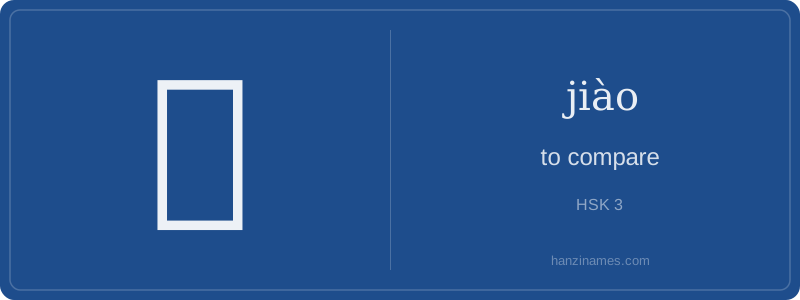
较 is widely used in modern Standard Chinese for comparative constructions, especially in formal writing, education, and media. It appears in HSK-3 textbooks and official documents — for instance, in phrases like '较为常见' (relatively common) or '较...为...' structures. A well-documented idiom is '计较' (jìjiào), meaning 'to quibble over details', showing 较’s historical link to evaluative scrutiny. It also appears in classical texts like the *Zuo Zhuan*, where it conveys measured judgment in diplomatic discourse.
较 is not a pictograph but a phono-semantic compound: the left radical 车 (chē, 'chariot') hints at its ancient phonetic component (now diverged), while the right component 交 (jiāo, 'to intersect, exchange') provides both sound and conceptual resonance — comparison involves an intersection of standards. No oracle bone form exists; its earliest attested form appears in Warring States bamboo slips (4th c. BCE), consistently used in evaluative contexts.
The Chinese character 较 (jiào) fundamentally means 'to compare' — but unlike English 'compare', which is neutral and often descriptive, 较 carries a subtle evaluative weight, implying judgment or relative assessment. It frequently appears in formal, written, or academic contexts, such as reports, exams, or policy analysis, where precision and hierarchy matter. Its use often signals that a conclusion has been drawn from comparison — not just observation, but ranking or calibration.
In Western linguistic frameworks, 'compare' (English), 'comparer' (French), or 'vergleichen' (German) emphasize process: examining similarities and differences. 较, by contrast, leans toward the *result* of comparison — especially when followed by adjectives like 高 (high), 低 (low), or 大 (large). This makes it functionally closer to English phrases like 'relatively' or 'as compared to', rather than the verb 'compare' alone.
This nuance reflects broader cultural tendencies: Chinese communication often privileges contextualized evaluation over abstract analysis. For example, saying 'A 较 B 优' ('A is superior *compared to* B') implies a socially or logically accepted standard — echoing Confucian ideals of relational hierarchy and measured virtue. In contrast, Western rhetoric may foreground individual metrics or detached comparison, as seen in scientific methodology or legal precedent analysis.
Example Sentences
Common Compounds
Similar Characters — Don't Mix These Up
Your First Step into Chinese Culture: Get a Chinese Name
Every journey into Chinese begins with a name. Use our free Chinese name generator to create a meaningful, personalized Chinese name that fits you perfectly.
Get My Chinese Name →