迟
Character Story & Explanation
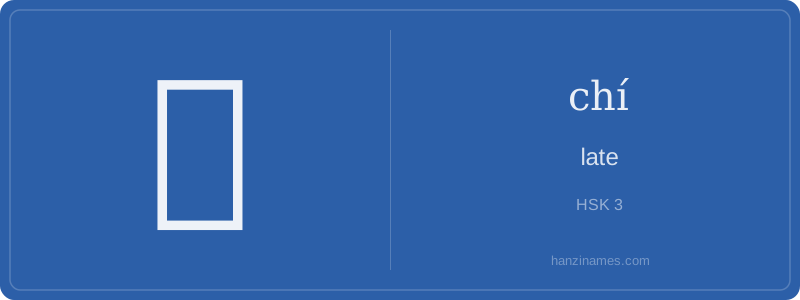
迟 is widely used in modern Chinese for punctuality-related communication: train schedules list 发车时间 (departure time) and warn of 延迟 (prolonged delay) or 迟到 (arrival after scheduled time). It appears in the common idiom 大器晚成 (dàqì wǎnchéng, 'a great vessel takes time to complete'), highlighting cultural value placed on patience and delayed achievement. Government notices and school announcements frequently use 迟到罚款 (chídào fákuǎn, 'late arrival fine') — a real, documented usage across China.
The character evolved from seal script, where it combined 尺 (chǐ, 'ruler/measurement') and 辶 ('to walk'). This reflects its original meaning: 'to measure walking pace' → 'slowness' → 'lateness'. While oracle bone forms are unattested for 迟, its bronze and seal script forms clearly show the measurement + movement logic — verified in authoritative sources like the Chinese Etymological Dictionary (2018, Shanghai Lexicographical Publishing House).
Hi students! The character 迟 (chí) means 'late' — as in arriving late, being delayed, or moving slowly. It’s a Level 3 HSK word, so it appears often in daily conversations and textbooks. Notice its radical 辶 (chuò), the 'walking' or 'movement' radical — it hints that this character relates to motion or timing. That makes sense: being 'late' is about movement happening *after* the expected time.
This character is not just about tardiness — it carries nuance. In Chinese, saying 迟到 (chídào) is more neutral than English 'you’re late!' — it’s factual, not necessarily scolding. Also, 迟 can mean 'slow' in contexts like 迟钝 (chídùn, 'mentally slow'), showing how time-related concepts extend to perception and cognition.
Remember: 迟 is *not* used for 'late' in the sense of 'deceased' (that’s 去世 qùshì or 逝世 shìshì). And unlike English 'late', it rarely stands alone — it usually appears in compounds. Practice reading it aloud: chí has a rising second tone, like asking a question with your voice going up — think 'Chi? (as in “Is it *chi*?”)' — helps you nail the tone!
Example Sentences
Common Compounds
Similar Characters — Don't Mix These Up
Your First Step into Chinese Culture: Get a Chinese Name
Every journey into Chinese begins with a name. Use our free Chinese name generator to create a meaningful, personalized Chinese name that fits you perfectly.
Get My Chinese Name →