那
Character Story & Explanation
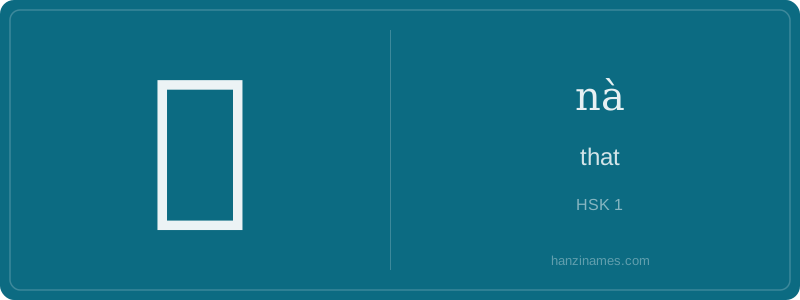
那 is ubiquitous in modern Mandarin: it appears in HSK 1 textbooks, daily conversations, news headlines, and formal writing. Common fixed phrases include 那么 (nàme, 'so/thus'), 那里 (nàlǐ, 'there'), and 那个 (nàge, 'that/um'—used as a filler like English 'like' or 'you know'). Historically, 那 evolved from the ancient character '迺' (nǎi), later standardized during the Qin dynasty’s script unification. Its current form—with the right-side 阝 (fù, 'city' radical) and left-side '亻+匕'—reflects phonetic-semantic compound structure, not pictographic origin.
The character’s shape has no pictorial origin (unlike 日 or 木); instead, it’s a phono-semantic compound: the left side '' (a variant of '亻+匕') suggests pronunciation, while the right-side 阝 indicates association with place or locality—consistent with its deictic function ('that [place/person/thing]'). Today, Chinese speakers use 那 constantly—not just for distance ('that building'), but as a softener ('那…我们走吧' — 'Well then… shall we go?'), showing its deep integration into pragmatic speech flow.
那 (nà) is one of the most frequently used demonstrative determiners in Mandarin, functioning much like English 'that', 'the', or 'those'—but with crucial grammatical differences. Unlike English, where 'the' is a definite article and 'that' is a demonstrative, 那 serves both roles contextually, often marking distance in space, time, or discourse (e.g., 'that idea over there' vs. 'the idea we just mentioned'). It’s uninflected—no plural form—and always precedes nouns without change.
In spoken Chinese, 那 carries strong pragmatic weight: it signals shared knowledge or prior reference, similar to how English speakers use 'the' after first mention ('I saw a cat. The cat was black.')—but 那 can do this even without prior introduction, relying on situational context. This reflects a broader East Asian linguistic tendency toward discourse-oriented deixis rather than strict syntactic definiteness.
Culturally, 那 subtly reinforces relational thinking: pointing to 'that' thing isn’t just spatial—it implies connection to speaker, listener, or shared experience. Compare Western individualist emphasis on object identity ('that specific apple') versus Chinese pragmatic focus on relational positioning ('that apple *over there*, the one you’re looking at'). This mirrors Confucian values of context-aware communication—meaning emerges not from the word alone, but from its place in the relational field.
Example Sentences
Common Compounds
Similar Characters — Don't Mix These Up
Your First Step into Chinese Culture: Get a Chinese Name
Every journey into Chinese begins with a name. Use our free Chinese name generator to create a meaningful, personalized Chinese name that fits you perfectly.
Get My Chinese Name →