除
Character Story & Explanation
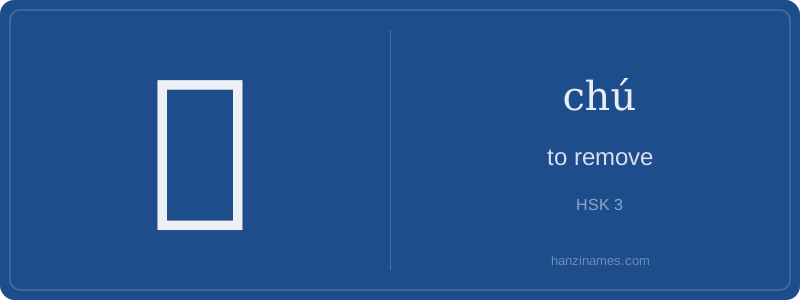
除 has been used since at least the Warring States period (475–221 BCE) in texts like the *Zuo Zhuan*, where it meant ‘to dismiss (an official)’ or ‘to expel (a person or force)’. Today, it’s essential in formal writing, legal documents, and mathematics — notably in 除法 (chúfǎ, ‘division’), taught in all Chinese primary schools. Common phrases include ‘排除万难’ (páichú wànnàn, ‘overcome countless difficulties’) and ‘例行检查,传染病除外’ (lìxíng jiǎnchá, chuánrǎnbìng chúwài, ‘routine check-up, except infectious diseases’).
The character’s form evolved from seal script: the left 余 originally depicted ‘leftover food in a vessel’, and the right 阝 (originally 邑 yì, ‘city’) indicates administrative action — reflecting ancient state practices of removing undesirables from territory. No oracle-bone form survives, but bronze inscriptions confirm its early use in bureaucratic contexts.
Hi students! Let’s explore 除 (chú), a Level 3 HSK character with 9 strokes and the right-side 'hill' radical 阝 (fù). Though it looks complex, it’s built logically: the left part 余 (yú) hints at ‘remaining’ or ‘surplus’, and the right part 阝 represents a ‘mound’ or ‘territory’ — together suggesting ‘removing what remains beyond necessity’. This reflects its core idea: eliminating something unwanted or unnecessary.
Don’t confuse 除 with simple ‘destruction’. It often implies careful, intentional removal — like clearing weeds before planting, or dismissing an official from duty. In modern Chinese, it appears in formal, administrative, and mathematical contexts (e.g., division: 除法). Its tone is neutral-to-formal — you’d say 除去垃圾 (chúqù lājī) for ‘remove garbage’, not 除掉垃圾 in casual speech unless emphasizing force.
Remember: 除 frequently pairs with other verbs to soften or specify meaning — 除去 (chúqù, ‘to remove’), 排除 (páichú, ‘to rule out’), and 除外 (chúwài, ‘except’) all rely on this root. Mastering 除 unlocks dozens of useful compounds — and helps you understand how Chinese builds abstract ideas from concrete actions like ‘clearing land’ or ‘dismissing officials’.
Example Sentences
Common Compounds
Similar Characters — Don't Mix These Up
Your First Step into Chinese Culture: Get a Chinese Name
Every journey into Chinese begins with a name. Use our free Chinese name generator to create a meaningful, personalized Chinese name that fits you perfectly.
Get My Chinese Name →