音
Character Story & Explanation
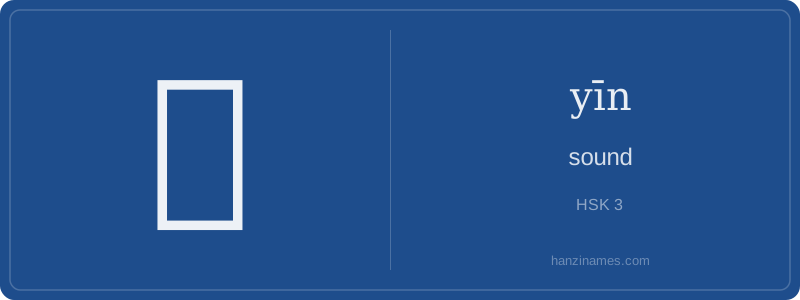
音 is ubiquitous in modern Chinese life: used in tech (耳机音量 'headphone volume'), education (标准发音 'standard pronunciation'), and daily expressions like 注意音量 ('mind the volume'). It appears in the classical idiom 五音不全 (wǔ yīn bù quán), meaning 'tone-deaf', referencing the five traditional musical notes — a phrase still commonly used today. The term 音乐 (yīnyuè) for 'music' dates back to at least the Zhou Dynasty (1046–256 BCE), appearing in texts like the Book of Rites.
The character 音 first appeared in bronze inscriptions (c. 11th–3rd century BCE) as a variant of 声 (shēng), with the addition of 日 (rì, 'sun/day') beneath 立 (lì, 'to stand'). Scholars believe this distinguishes intentional, harmonious sound (音) from raw voice/noise (声), emphasizing clarity and cultural refinement — not a pictograph of an object, but a conceptual refinement.
Hi students! Let’s explore 音 (yīn), a foundational character meaning 'sound' — not just noise, but any audible phenomenon: music, speech, tone, or even silence implied by sound. It’s the root of many important words like 音乐 (yīnyuè, 'music') and 发音 (fāyīn, 'pronunciation'). Though it looks simple, its structure reflects ancient Chinese thinking about sound as something structured and meaningful — not random noise.
This character appears early in HSK Level 3, signaling your move into more abstract and functional vocabulary. You’ll see it everywhere: in language learning (e.g., 声音 vs. 音), technology (音响 'speaker'), and culture (音调 'tone' in Mandarin tones). Mastering 音 helps you understand how Chinese links hearing, meaning, and expression — making it far richer than just 'sound'.
Don’t confuse 音 with 声 (shēng), which means 'voice' or 'noise' — more physical and immediate. 音 carries a sense of intention, pattern, or resonance: think of musical notes, spoken syllables, or recorded audio. That nuance matters! As you practice writing its 9 strokes, notice how the top part (立) suggests 'standing upright' — symbolizing clarity and presence — while the bottom (日) evokes 'daylight', implying something clear and perceptible. This is how Chinese characters layer meaning visually.
Example Sentences
Common Compounds
Similar Characters — Don't Mix These Up
Your First Step into Chinese Culture: Get a Chinese Name
Every journey into Chinese begins with a name. Use our free Chinese name generator to create a meaningful, personalized Chinese name that fits you perfectly.
Get My Chinese Name →