饱
Character Story & Explanation
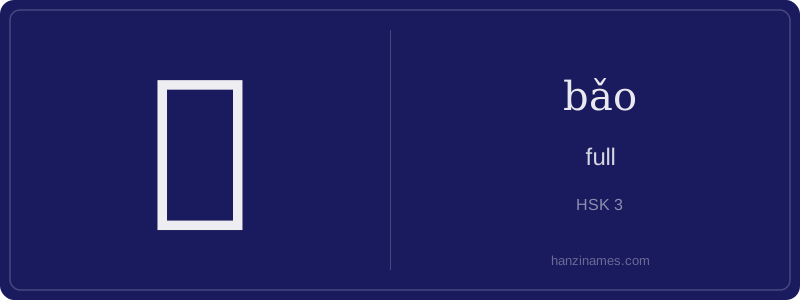
In modern Mandarin, 饱 is indispensable in daily expressions of physical well-being and social etiquette. It appears in the HSK-3 phrase 吃饱了 (chī bǎo le)—a polite, near-universal post-meal declaration meaning 'I’ve eaten enough,' signaling respect for the host and personal self-regulation. The idiom 饱经风霜 (bǎo jīng fēng shuāng, 'fully experienced wind and frost') metaphorically extends the character to mean 'deeply experienced' or 'weathered by hardship,' widely used in literature and news media since at least the Qing Dynasty.
The character’s form originates from the late Warring States period small seal script, where 饣 (a simplified variant of 食, ‘food’) consistently served as the semantic component, and 包 (bāo) provided phonetic guidance. No oracle bone inscriptions contain 饱—its earliest secure attestations appear in Qin bamboo slips (c. 3rd century BCE), confirming its emergence as a functional, phonosemantic compound tied to dietary practice—not mythic symbolism.
As an archaeologist sifting through layers of linguistic sediment, I uncover 饱 not as a static glyph but as a cultural artifact shaped by millennia of agrarian rhythm and communal dining. Its earliest attested forms in seal script (c. 3rd century BCE) already bear the food radical 饣—evidence that fullness was linguistically anchored to sustenance long before standardized dictionaries existed. This wasn’t abstract satiety; it was the visceral relief after harvest feasts or the quiet dignity of elders finishing their rice bowls.
The character’s eight-stroke composition reveals deliberate economy: the left-side 饣 (food) signals domain, while the right-side 包 (bāo, ‘to wrap/contain’) morphs into a compact phonetic-semantic compound—literally ‘food wrapped within,’ evoking the belly as vessel. Unlike characters born from celestial omens, 饱 emerged from embodied experience: the pause after eating, the loosening of the belt, the satisfied sigh echoing across Han dynasty banquet texts and Tang poetry alike.
Excavating later usage, I find 饱 embedded in bureaucratic grain ledgers of the Ming Dynasty and medical treatises warning against ‘excessive fullness’ (过饱) as pathogenic—a testament to its dual role in both nourishment and restraint. Even today, when Chinese parents urge children to ‘eat until full’ (吃饱), they invoke a physiological imperative encoded in bronze inscriptions and inked on bamboo slips. 饱 is not merely lexical—it’s a fossilized gesture of survival, reverence, and balance.
Example Sentences
Common Compounds
Similar Characters — Don't Mix These Up
Your First Step into Chinese Culture: Get a Chinese Name
Every journey into Chinese begins with a name. Use our free Chinese name generator to create a meaningful, personalized Chinese name that fits you perfectly.
Get My Chinese Name →