黄
Character Story & Explanation
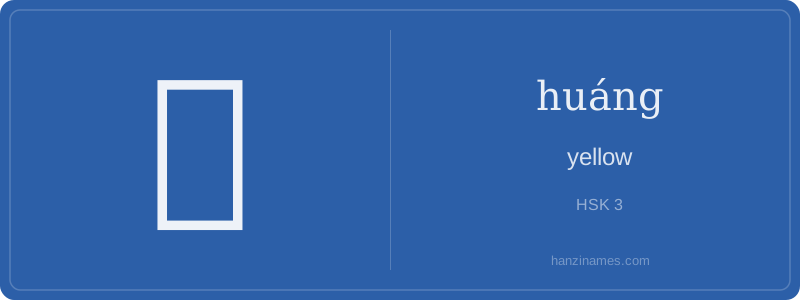
In Beijing’s Forbidden City, visitors see 黄 tile roofs on major halls — a visual declaration of imperial privilege, since yellow-glazed tiles were reserved exclusively for the emperor during the Ming and Qing dynasties. Today, 黄 remains ubiquitous: on school buses (‘yellow bus’ signage), sunflower seeds (向日葵种子), and weather alerts (黄色预警 ‘yellow warning’ for moderate typhoons or smog). The idiom ‘面黄肌瘦’ (miàn huáng jī shòu) — literally ‘yellow face, thin muscles’ — has been used since the Song dynasty to describe malnourishment, still heard in medical and literary contexts.
The character’s earliest confirmed form appears in Western Zhou bronze inscriptions (c. 1000 BCE) as a pictograph resembling a person wearing a headdress with dangling ornaments — possibly representing ceremonial regalia linked to earth and harvest. While later forms evolved, the core association with earthy tones and centrality persisted through seal and clerical scripts into modern standard writing.
The character 黄 (huáng) is one of the most culturally resonant color terms in Chinese — not just a hue, but a symbol of imperial authority, fertile soil, and ancestral identity. Its 11-stroke structure balances symmetry and flow: beginning with the top horizontal stroke, then descending through interlocking components that evoke ancient bronze inscriptions. Unlike many radicals, 黄 serves both as an independent character and as its own radical — a rare self-contained semantic unit.
Historically, 黄 was associated with the Yellow Emperor (Huáng Dì), legendary founder of Han Chinese civilization, and with the Huang He (Yellow River), whose loess-rich silt gave the water its name and nourished China’s agrarian heartland. This deep-rooted connection means 黄 carries weight beyond chromatic description — it signals centrality, dignity, and origin.
In modern usage, 黄 appears across contexts: from traffic lights and warning signs (yellow = caution) to food labeling (e.g., 黄油 ‘butter’) and slang (e.g., 黄色 ‘yellow’ as a euphemism for vulgar content, regulated under Chinese internet laws). Its dual role — literal color and cultural signifier — makes mastering 黄 essential for understanding both everyday language and layered social meaning.
Example Sentences
Common Compounds
Similar Characters — Don't Mix These Up
Your First Step into Chinese Culture: Get a Chinese Name
Every journey into Chinese begins with a name. Use our free Chinese name generator to create a meaningful, personalized Chinese name that fits you perfectly.
Get My Chinese Name →