民
Character Story & Explanation
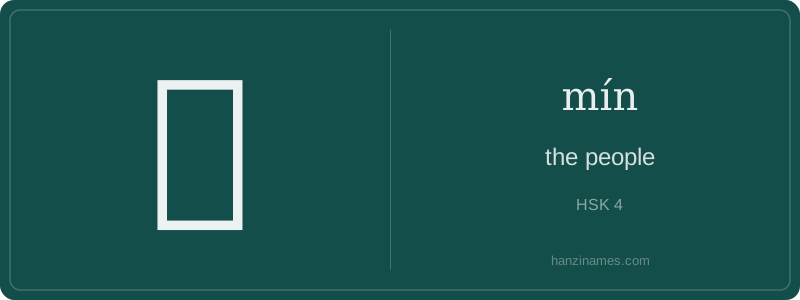
民 is central to modern Chinese political language — appearing in official names like the People’s Republic of China (中华人民共和国, Zhōnghuá Rénmín Gònghéguó) and institutions such as the People’s Bank of China (中国人民银行). It’s also in common idioms like ‘民以食为天’ (mín yǐ shí wéi tiān), meaning 'food is heaven to the people', highlighting its link to livelihood and welfare. Historically, it was used in pre-Qin texts to distinguish subjects from rulers — a concept later enshrined in Mao-era slogans like '全心全意为人民服务' (serve the people wholeheartedly).
The earliest attested form of 民 appears on Warring States bamboo slips and Qin dynasty seals. Scholars agree it originally depicted a bound person (suggesting early connotations of subjecthood), but by the Han dynasty, it had fully shifted to mean 'common people' with moral and social significance — a usage confirmed by excavated texts like the *Guodian Chu Slips*. No oracle bone form survives, so its Shang dynasty origin remains unknown.
Hi students! The character 民 (mín) means 'the people' — not just any people, but ordinary citizens, the general public, especially in contrast to rulers or elites. It’s a foundational word for understanding Chinese society and governance. You’ll see it everywhere: in news headlines, government slogans, and even everyday expressions like 'people’s park' or 'people’s bank'. Its simplicity (just 5 strokes!) belies its deep cultural weight — it appears in classical texts like the *Analects* and modern constitutional language alike.
This character is one of the earliest written forms still in use today. Unlike many characters that evolved from pictographs, 民 has a stable form since the Warring States period (475–221 BCE). In ancient bronze inscriptions, it already resembled today’s shape — suggesting continuity in how Chinese thinkers conceptualized 'the people' across millennia. It carries dignity and collective identity, never mere 'population' or 'masses'.
As an HSK Level 4 character, 民 appears in key vocabulary related to society, law, and policy. It’s often the first component in compound words (like 民主 'democracy'), so mastering it unlocks dozens of important terms. Remember: it’s always neutral or positive — never used pejoratively like 'mob' or 'rabble'. When you read 民, think of shared responsibility, civic life, and community — core values reflected in both traditional Confucian thought and modern Chinese discourse.
Example Sentences
Common Compounds
Similar Characters — Don't Mix These Up
Your First Step into Chinese Culture: Get a Chinese Name
Every journey into Chinese begins with a name. Use our free Chinese name generator to create a meaningful, personalized Chinese name that fits you perfectly.
Get My Chinese Name →