乒
Character Story & Explanation
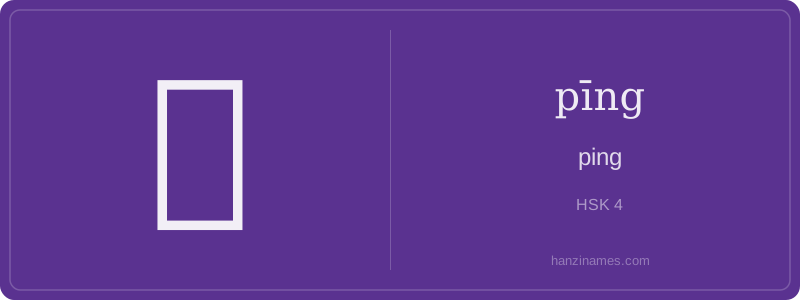
乒 appears almost exclusively in compounds related to table tennis (ping-pong), especially in the reduplicated term 乒乓 (pīngpāng), used for the sport itself, its sound, or colloquially for ‘back-and-forth’ activity (e.g., 乒乓打字 means rapid typing). It is never used alone in modern Mandarin—no dictionary lists it as a standalone word. Historically, 乒 first appeared in early 20th-century transliterations of English 'ping-pong', adopted officially by the Chinese Table Tennis Association in the 1950s as part of state-promoted sports literacy.
The character has no ancient origin—it is a modern phono-semantic compound created in the 1910s–20s. Its shape derives from simplification of older forms (like 並 + 丿), but its function is purely phonetic. Today, Chinese learners encounter it first in phrases like 乒乓球 (pīngpāngqiú, 'table tennis ball')—a fixture in school PE, neighborhood courts, and Olympic broadcasts.
The character 乒 (pīng) is a phonetic loan character—its form bears no semantic relationship to its meaning, yet it embodies a uniquely Chinese linguistic pragmatism: when sound matters more than sense, the script adapts. Its six strokes—beginning with the radical 丿 (piě, 'left-falling stroke')—are minimal and rhythmic, mirroring the sharp, staccato sound of a ping-pong ball striking the paddle. This economy of form reflects the Daoist ideal of wúwéi (effortless action): maximum expressiveness with minimal stroke.
Unlike pictographs or ideographs rooted in nature or morality, 乒 emerges from onomatopoeia—a sonic imprint frozen in ink. In Chinese worldview, sound is not secondary to meaning; it *is* meaning. The sharp ‘pīng’ evokes immediacy, precision, and energetic reciprocity—qualities central to both table tennis and Confucian dialogue, where response must be timely, clear, and balanced.
This character also reveals how modernity reshapes tradition: 乒 was virtually unused before the 20th century, then rose alongside China’s embrace of global sport and scientific terminology. Its inclusion in HSK Level 4 signals not just linguistic utility, but cultural diplomacy—the quiet triumph of a Sino-phonetic coinage recognized worldwide. To write 乒 is to participate in a living lexicon where language, sport, and national identity resonate in unison.
Example Sentences
Common Compounds
Similar Characters — Don't Mix These Up
Your First Step into Chinese Culture: Get a Chinese Name
Every journey into Chinese begins with a name. Use our free Chinese name generator to create a meaningful, personalized Chinese name that fits you perfectly.
Get My Chinese Name →