五
Character Story & Explanation
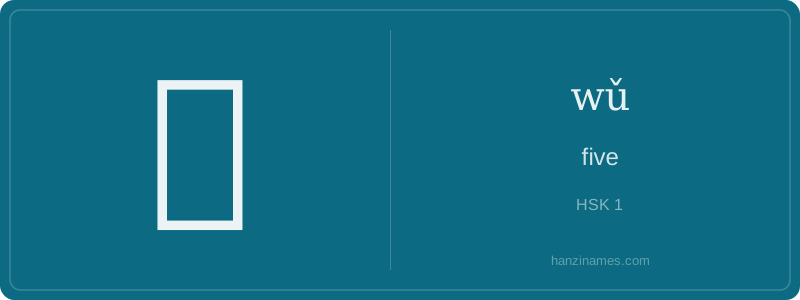
五 is ubiquitous in modern Chinese: used daily in counting, time (e.g., 五点 wǔ diǎn — 'five o’clock'), addresses (e.g., 五号路 Wǔ Hào Lù — 'No. 5 Road'), and formal contexts like the 'Five Elements' (五行 wǔ xíng) and 'Five Relationships' (五伦 wǔ lún) in Confucian ethics. It appears in idioms like 三番五次 (sān fān wǔ cì — 'repeatedly') and the historical 'Five-Year Plans' (五年计划 wǔ nián jìhuà), first launched in 1953 and still in use.
The character’s origin is abstract—not pictographic. Oracle bone inscriptions show no visual reference to five objects; instead, 五 emerged as a unique, non-imitative symbol, possibly derived from a knot or tally mark convention. Its enduring form reflects early Chinese numeracy’s emphasis on symbolic distinction over representation.
As a detective tracing the evolution of 五, I begin at the oracle bone script (c. 1200 BCE), where it appeared not as a pictograph but as an abstract, symmetrical glyph—two parallel horizontal lines with an 'X'-shaped or crossed stroke between them. This wasn’t a picture of five objects, but a deliberate, balanced signifier for the numeral, likely designed to distinguish it from 二 (two) and 三 (three) through structural contrast rather than quantity depiction.
By the bronze script era (c. 1000–700 BCE), the crossing stroke stabilized into a clear '×', and the top and bottom horizontals became more uniform—reflecting standardization under ritual inscription practices. The radical 二 (two) appears in its modern form at the top, anchoring it within the numeral family, while the lower cross evolved into the distinctive '乂' shape seen today—no longer a literal count, but a conventionalized symbol recognized across states during the Warring States period.
In the small seal script (Qin dynasty, 3rd c. BCE), 五 was further regularized: the two horizontal strokes flattened, the central cross sharpened into intersecting diagonals, and spacing tightened. The clerical script then softened the angles, leading to the modern regular script we use now—where the four strokes (horizontal, horizontal, left-falling, right-falling) preserve the ancient symmetry while optimizing brushstroke flow. Its stability over 3,000 years testifies to its functional clarity—not as a drawing, but as a calibrated sign.
Example Sentences
Common Compounds
Similar Characters — Don't Mix These Up
Your First Step into Chinese Culture: Get a Chinese Name
Every journey into Chinese begins with a name. Use our free Chinese name generator to create a meaningful, personalized Chinese name that fits you perfectly.
Get My Chinese Name →