傲
Character Story & Explanation
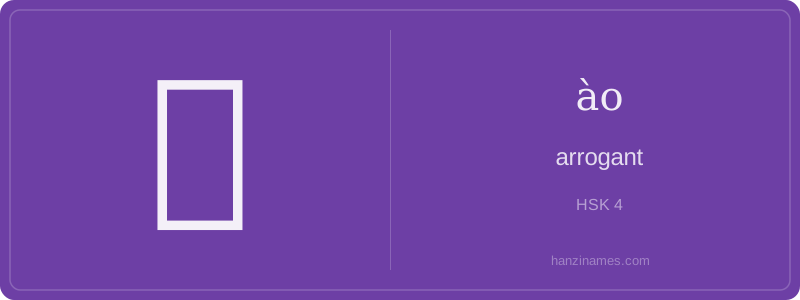
傲 is frequently used in modern Chinese to criticize dismissive or elitist behavior—especially in education, workplace feedback, and media commentary. A common idiom is 骄傲自满 (jiāo’ào zìmǎn), meaning 'complacent and arrogant', often cited in Party-led campaigns promoting humility and continuous learning. Historically, it appears in the 3rd-century CE dictionary Shuōwén Jiězì, classified under 人 (rén, 'person') radical, confirming its focus on human attitude.
The character combines 亻 (person) and 敖 (áo, 'to wander leisurely; to be unrestrained'), which itself evolved from ancient forms suggesting 'a person raising arms in defiant display'. By the Han dynasty, 敖 had acquired connotations of insolence—making 傲 a deliberate lexical pairing for moral censure of unbridled self-importance.
傲 (ào) conveys a complex, culturally nuanced sense of pride—often with strong negative connotations in Chinese. Unlike English 'proud', which can be neutral or positive (e.g., 'proud parent'), 傲 typically implies arrogance, haughtiness, or disdainful superiority. It suggests an attitude that violates Confucian ideals of humility, respect, and self-restraint—making it morally weighted rather than emotionally descriptive.
This character reflects China’s deep-rooted relational ethics: one’s standing is defined not by self-assertion but by harmonious conduct toward others. In classical texts like the Analects, figures who display 傲 are criticized for disrupting social order. Even today, calling someone 傲 is a serious social rebuke—not merely ‘confident’, but ‘unbearably condescending’.
Western equivalents like 'arrogant' or 'haughty' come closest—but lack 傲’s embedded critique of moral failing. 'Proud' alone misleads; 'smug', 'uppity', or 'lordly' capture more texture. Crucially, 傲 rarely appears in isolation—it thrives in compounds (e.g., 骄傲, 傲慢), where its judgmental force intensifies. Understanding it requires grasping how Chinese culture frames self-regard as inherently social—and therefore ethically accountable.
Example Sentences
Common Compounds
Similar Characters — Don't Mix These Up
Your First Step into Chinese Culture: Get a Chinese Name
Every journey into Chinese begins with a name. Use our free Chinese name generator to create a meaningful, personalized Chinese name that fits you perfectly.
Get My Chinese Name →