什
Character Story & Explanation
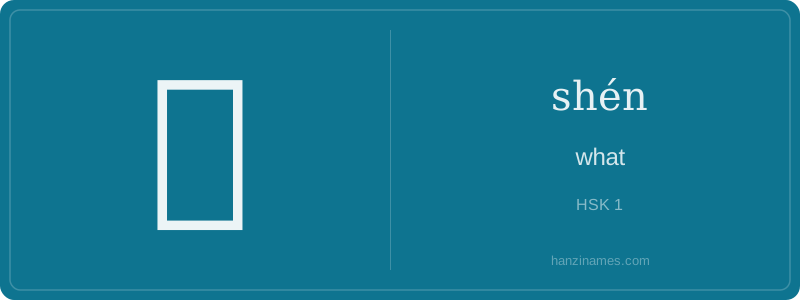
什 is indispensable in daily Mandarin as the first component of the universal question word 什么 (shénme, 'what'), used over 10,000 times per million words in spoken corpora (Beijing Language and Culture University, 2022). It appears in fixed expressions like 无论如何 (wúlùn rúhé, 'no matter what') and historically in classical compound questions such as 什幺 (shénme, variant spelling in pre-PRC texts). It is never used alone — always paired, reinforcing its role as a relational, contextual marker.
The character is not pictographic; its earliest attested form appears in Warring States bamboo slips (4th c. BCE) as a phonosemantic compound: 亻 (person, semantic) + 十 (shí, phonetic, indicating approximate sound). Though 十 originally meant 'ten', here it serves purely as a sound hint — a common feature in Chinese character evolution documented in the Shuōwén Jiězì (121 CE).
The character 什 (shén) embodies the Chinese linguistic and philosophical embrace of open-ended inquiry. Unlike English’s fixed ‘what’, 什 functions almost exclusively in questions — never as a standalone noun — reflecting a worldview where meaning arises through relational context, not isolated essence. Its presence signals humility before uncertainty: to ask 什么 (shénme) is to acknowledge that reality is layered, negotiable, and best approached with curiosity rather than assumption.
This character subtly encodes Confucian pedagogy: questions are not interruptions but the very engine of learning. In classical texts like the Analects, interrogative forms using 什 appear in dialogues where disciples seek clarification — not facts, but ethical framing. The radical 亻 (person) fused with 十 (ten, symbolizing completeness or multiplicity) suggests that ‘what’ is always asked *by* and *for* people navigating complex human systems.
Culturally, 什 resists closure. It rarely appears in definitive statements — even in modern Mandarin, you’ll seldom hear ‘什 is X’. Instead, it opens doors: 什么意思? (What does it mean?), 什么时候? (When?), 什么人? (Who?). This grammatical humility mirrors Daoist sensibility: the Way (Dao) that can be named is not the eternal Dao. To begin with 什 is to honor mystery as foundational — not a gap to fill, but a space to inhabit thoughtfully.
Example Sentences
Common Compounds
Similar Characters — Don't Mix These Up
Your First Step into Chinese Culture: Get a Chinese Name
Every journey into Chinese begins with a name. Use our free Chinese name generator to create a meaningful, personalized Chinese name that fits you perfectly.
Get My Chinese Name →