入
Character Story & Explanation
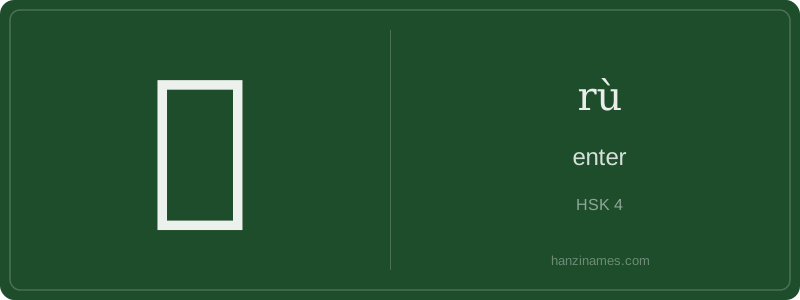
In daily life, 入 is indispensable: it appears on subway station signs (入閘 'enter the turnstile'), university admission notices (錄取入學 'admitted and enrolled'), and tax forms (收入 'income', literally 'enter + receive'). The idiom 深入淺出 ('deeply enter, simply express')—used since the Ming dynasty to praise clear teaching of complex ideas—demonstrates its enduring role in intellectual discourse. Historically, 入 governed legal entry rights: Tang Code stipulated 'non-citizens may not 入 city walls without permit.'
Archaeologically, 入 is confirmed as one of the earliest standardized characters: its oracle bone form () is a clear pictograph of a foot crossing a line—representing threshold-crossing. No animal, object, or deity is depicted; only motion across a boundary. This functional minimalism explains why it retained just two strokes for over 3,200 years.
Our detective begins in the Shāng dynasty oracle bone inscriptions (c. 1200 BCE), where 入 appears as a simple, downward-slanting stroke intersecting a short horizontal—resembling a person stepping across a threshold or an arrow piercing inward. Unlike many characters that evolved from complex pictographs, 入 was minimalist from the start: its two strokes encoded directionality and penetration, not anatomy or objects. Early bronze inscriptions preserved this stark form, confirming its function as a verb of motion toward interiority.
By the Warring States period, scribes standardized 入’s shape into the modern structure: a diagonal stroke (piě) descending left-to-right, followed by a shorter, inward-curving捺 (nà). Calligraphic variations existed, but the semantic core remained immutable—to cross a boundary, to become part of something larger. This stability is rare: while characters like 木 (tree) accumulated decorative strokes over millennia, 入 shed all ornamentation, becoming a linguistic scalpel for ingress.
The character never developed independent noun usage in classical texts—it always required context (e.g., 入門 'enter a gate', 入學 'enter school'). Its grammatical versatility emerged later: as a verb prefix (入神 'become entranced'), a classifier-like marker in compound verbs (入賬 'enter into accounts'), and even in abstract domains like mathematics (入位 'carry over' in addition). This semantic elasticity—grounded in physical entry yet stretching into cognition, finance, and ritual—makes 入 a quiet powerhouse of Chinese syntax.
Example Sentences
Common Compounds
Similar Characters — Don't Mix These Up
Your First Step into Chinese Culture: Get a Chinese Name
Every journey into Chinese begins with a name. Use our free Chinese name generator to create a meaningful, personalized Chinese name that fits you perfectly.
Get My Chinese Name →