剩
Character Story & Explanation
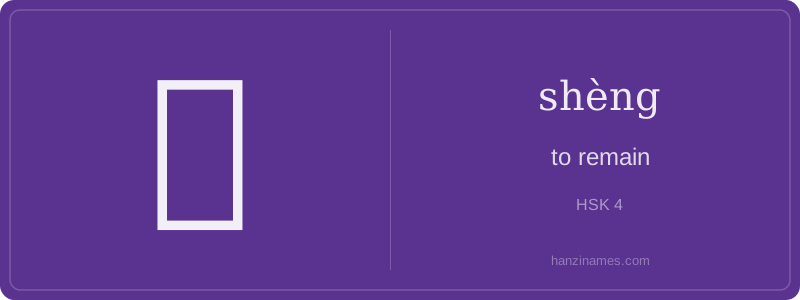
剩 is ubiquitous in modern Mandarin: seen on restaurant receipts (‘剩余金额’), subway announcements (‘剩余时间’), and WeChat payment confirmations (‘余额剩余’). A well-documented phrase is 剩男/剩女 (shèngnán/shèngnǚ), coined in early 2000s state media to describe unmarried urban professionals over age 27–30 — sparking national debate about marriage, gender roles, and social expectations. The term entered official discourse via Xinhua News Agency and Ministry of Civil Affairs reports.
剩 is a phono-semantic compound: the left side 乘 (chéng, ‘to ride, to multiply’) provides sound (shèng shares ancient phonetic links with chéng), while the right-side 刂 (knife radical) signals semantic association with cutting/separating — reflecting its core meaning: what *remains after division or reduction*. No oracle-bone or bronze script form survives; it first appeared in seal script during the Qin dynasty (3rd c. BCE) as a standardized administrative character for inventory and ration tracking.
The Chinese character 剩 (shèng) conveys the idea of what remains after something has been used, consumed, or removed — not merely 'leftover' as a static noun, but an active state of persistence. Unlike English ‘leftover’, which often carries culinary or dismissive connotations (e.g., ‘just leftovers’), 剩 emphasizes neutral factual residue: time remaining, money left in an account, or unspent resources. It’s grammatically versatile — functioning as both verb (‘to remain’) and adjective (‘remaining’), and it appears in formal policy documents, financial reports, and everyday speech alike.
Western equivalents like ‘residual’, ‘surplus’, or ‘remainder’ only partially overlap. ‘Residual’ leans scientific or legal; ‘surplus’ implies excess, often positive (e.g., surplus goods), whereas 剩 is value-neutral — even slightly cautionary (e.g., 剩饭 ‘leftover rice’ may evoke frugality or food waste concerns). In Confucian-influenced contexts, 剩 subtly invokes ideals of moderation: avoiding waste aligns with virtue, making ‘what remains’ a quiet moral metric.
This cultural nuance surfaces in idioms like 剩者为王 (shèng zhě wéi wáng, ‘the survivor becomes king’), borrowed from Darwinian phrasing but widely used in business and competitive exams — revealing how ‘remaining’ is framed not as passive survival, but as strategic endurance. Unlike Western individualism that celebrates ‘winning’, 剩 here reflects collective pragmatism: staying viable amid scarcity or pressure is itself achievement.
Example Sentences
Common Compounds
Similar Characters — Don't Mix These Up
Your First Step into Chinese Culture: Get a Chinese Name
Every journey into Chinese begins with a name. Use our free Chinese name generator to create a meaningful, personalized Chinese name that fits you perfectly.
Get My Chinese Name →