住
Character Story & Explanation
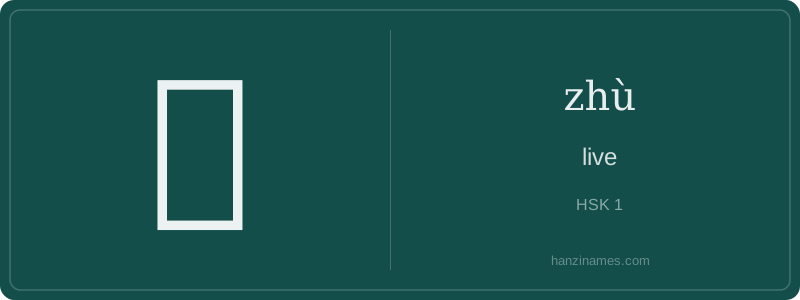
In daily life, 住 is indispensable: rental contracts, ID cards (住址), and subway announcements ('Please stand clear of the doors until the train has come to a complete stop' → 列车停稳后再下车) all rely on it. A well-documented phrase is 住口 (zhù kǒu, 'shut your mouth'), appearing in the 14th-century classic Water Margin as a command to cease speaking—showing its extended use for halting action beyond physical residence.
The character is not pictographic. It evolved from seal script, where 主 (master/host) was combined with 亻 (person) to form a logical compound—no sun, tree, or animal imagery. Its modern form, standardized in the 1956 PRC script reform, preserves that structure faithfully: two distinct components fused into one functional unit.
As an archaeologist brushing dust from a Han dynasty bamboo slip, I find 住 etched with confident strokes—no oracle-bone mystery here, but a clear semantic evolution. Its left radical 亻 (person) anchors it in human action, while the right component 主 (zhǔ, 'master' or 'host') originally conveyed authority over a space. By the Warring States period, this pairing crystallized into 'to dwell': not merely occupying space, but claiming stewardship of a residence.
The character’s stability across 2,300 years is remarkable: unearthed Qin legal texts use 住 to specify where conscripts ‘reside during service’, and Tang dynasty tax registers list household heads by 住所 (residence). Unlike many characters reshaped by calligraphic trends, 住 retained its seven-stroke structure from clerical script onward—proof of its functional centrality in administrative language.
This isn’t a fossil—it’s a living artifact. Modern Mandarin preserves its ancient core meaning while expanding pragmatically: 住 can mark temporary stay (住酒店), long-term residence (住北京十年), or even stative cessation (住手! ‘Stop!’). That last usage, documented since Ming vernacular novels, reveals how deeply ‘staying’ is wired into Chinese conceptual grammar—not just physical location, but the suspension of motion itself.
Example Sentences
Common Compounds
Similar Characters — Don't Mix These Up
Your First Step into Chinese Culture: Get a Chinese Name
Every journey into Chinese begins with a name. Use our free Chinese name generator to create a meaningful, personalized Chinese name that fits you perfectly.
Get My Chinese Name →