危
Character Story & Explanation
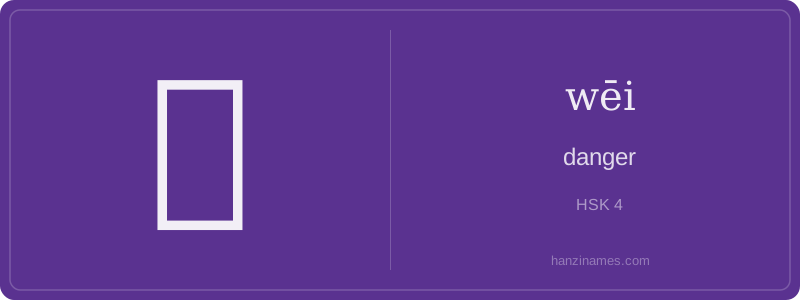
In daily modern usage, 危 appears in high-frequency terms like 危险 (wēixiǎn, 'danger'), 危机 (wēijī, 'crisis'), and official signage (e.g., 危险!'Danger!'). It is central to the idiom 居安思危 (jū ān sī wēi)—'while safe, think of danger'—a Confucian principle taught in textbooks and quoted by leaders to advocate vigilance. Historically, it features in Tang dynasty poetry (e.g., Du Fu’s 'The thatched hut blown away by autumn gales') describing perilous living conditions.
The character’s form is documented: bronze inscriptions show 人 (person) above 㔾 (a cliff or elevated platform). This is not hypothetical—it matches excavated vessel inscriptions where 危 describes rulers 'perched precariously' on unstable thrones. The structure reflects observable topography, not mythic invention.
As an archaeologist sifting through layers of script evolution, I trace 危 back to its earliest secure attestation in bronze inscriptions of the Western Zhou (c. 1046–771 BCE). Unlike speculative oracle-bone reconstructions, the character appears consistently with a human figure (人) atop a cliff-like structure (㔾), signaling precarious elevation—a concrete, observable source of danger in ancient settlement patterns and ritual geography.
This visual logic persisted: the radical 㔾 (a variant of 卩, originally denoting a kneeling person or boundary marker) anchors 危 not as abstract peril, but as spatial instability—standing too high, too exposed, too unmoored. Early texts like the *Book of Documents* use 危 to describe unstable political authority or morally compromised rulers—'dangerous' precisely because their position lacks ethical or structural foundation.
By the Han dynasty, 危 had lexicalized into both noun and adjective, appearing in medical manuscripts (*Mawangdui Silk Texts*) to denote life-threatening conditions and in philosophical discourse (*Huainanzi*) to describe cognitive peril—misjudging reality. Its semantic field expanded from physical hazard to systemic, moral, and epistemic risk, revealing how ancient Chinese conceptualized danger not as mere threat, but as a failure of balance, position, or virtue.
Example Sentences
Common Compounds
Similar Characters — Don't Mix These Up
Your First Step into Chinese Culture: Get a Chinese Name
Every journey into Chinese begins with a name. Use our free Chinese name generator to create a meaningful, personalized Chinese name that fits you perfectly.
Get My Chinese Name →