却
Character Story & Explanation
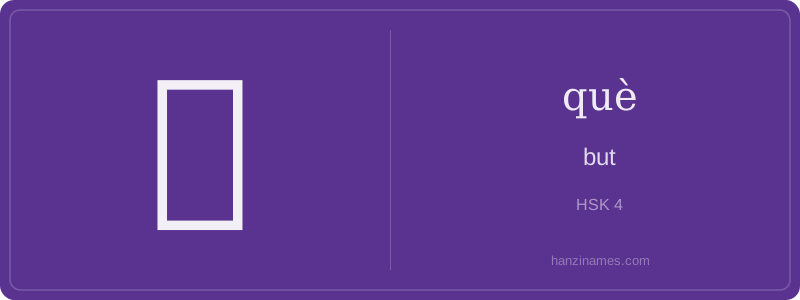
却 is ubiquitous in modern Mandarin, especially in written and formal speech, to express contrast or unexpected reversal. It appears in HSK-4+ materials, news reports, and literature—for example, in the common phrase '却没想到' (què méi xiǎng dào, 'but didn’t expect'), signaling ironic turns. It’s essential in idioms like '望而却步' (wàng ér què bù, 'to recoil at the sight'), historically used since the Song dynasty to describe hesitation before daunting challenges.
The character evolved from seal script; its left component (去) means 'to go away', and right (卩) is the 'seal' or 'kneeling figure' radical—originally suggesting 'to withdraw formally'. By the Han dynasty, it was standardized as a conjunction meaning 'yet, however', reflecting bureaucratic precision in classical documents where nuanced qualification mattered more than blunt contradiction.
At first glance, 却 (què) appears simple—just a humble conjunction meaning 'but'—yet it carries the quiet weight of Chinese dialectical thinking. Unlike English 'but', which often signals contradiction or dismissal, 卻 introduces nuance, restraint, and respectful qualification. It reflects the Confucian value of *zhongyong* (the Doctrine of the Mean): not rejecting an idea outright, but tempering it with balance, humility, or contextual awareness. This subtle pivot embodies how Chinese communication prioritizes harmony over confrontation.
In classical texts, 却 frequently marks graceful reversals—not abrupt refusals, but measured withdrawals or gentle corrections. A minister might 'decline an imperial favor 却之不恭' (refusing would be impolite), revealing how even negation is framed as relational duty. The character thus encodes a worldview where truth isn’t absolute but situated: every affirmation invites its quiet counterpoint, not as opposition, but as necessary complement—like yin to yang.
This linguistic modesty extends into modern life: saying '我很好,却有点累' (I’m fine, but a bit tired) doesn’t undermine the first clause—it deepens authenticity through layered honesty. 却 invites listeners to hold complexity without resolution, mirroring Daoist acceptance of paradox. In a culture that values indirectness and face-saving, 却 is less a grammatical hinge than a cultural pause button—honoring both sides of reality, never reducing the world to binary yes/no.
Example Sentences
Common Compounds
Similar Characters — Don't Mix These Up
Your First Step into Chinese Culture: Get a Chinese Name
Every journey into Chinese begins with a name. Use our free Chinese name generator to create a meaningful, personalized Chinese name that fits you perfectly.
Get My Chinese Name →