和
Character Story & Explanation
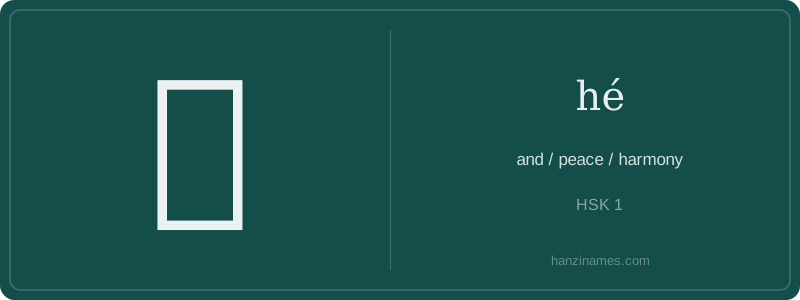
和 (hé) appears over 20,000 times in the modern Chinese corpus (BCC Corpus), consistently ranking among the top 20 most frequent characters. It's central in idioms like 和平 (hépíng, 'peace'), 和气生财 (héqì shēng cái, 'harmony brings prosperity' — a common shop motto), and the Confucian phrase 和而不同 (hé ér bù tóng, 'harmonious yet distinct'). Historically, 和 was inscribed on bronze vessels during the Western Zhou dynasty (c. 1046–771 BCE) as a term for ritual concord and social balance.
The character combines 口 (mouth) and 禾 (grain/stalk), reflecting its earliest documented meaning: 'harmony' as the peaceful coexistence of voices and resources. Unlike folk-etymologies claiming 'mouth + grain = sharing food', scholars confirm its Shang-Zhou origin as a phonosemantic compound where 禾 provided sound (ancient *ɡʷaːl) and 口 conveyed the semantic field of speech and agreement.
Hello, learners! The character 和 (hé) is one of the most essential and frequently used characters in Chinese — it’s your go-to word for 'and' in sentences like 'tea and coffee' or 'Mom and Dad'. It appears early in HSK Level 1 because it’s indispensable for building simple, natural-sounding phrases. Its pronunciation hé is by far the most common; the other readings (hè, hú, huó, huò) are specialized — used only in poetry, music, mahjong, or chemistry contexts.
Notice its radical 口 (kǒu), meaning 'mouth' — a clue that 和 often relates to spoken harmony: agreeing, singing together, or speaking peacefully. Though it looks simple (just 8 strokes!), mastering its balanced structure helps you write many related characters confidently. Practice writing it stroke-by-stroke: start with the left 口, then the right part (禾), keeping both sides aligned and proportionate.
Don’t confuse 和 with other 'and'-like words like 跟 (gēn) or 与 (yǔ) — 和 is neutral, formal enough for writing but friendly enough for daily speech. It’s also the heart of China’s cultural ideal of harmony (héxié) — think of family meals, diplomatic talks, or even the Confucian principle 'harmony without uniformity' (和而不同). This depth makes 和 much more than a conjunction — it’s a cultural key.
Example Sentences
Common Compounds
Similar Characters — Don't Mix These Up
Your First Step into Chinese Culture: Get a Chinese Name
Every journey into Chinese begins with a name. Use our free Chinese name generator to create a meaningful, personalized Chinese name that fits you perfectly.
Get My Chinese Name →