受
Character Story & Explanation
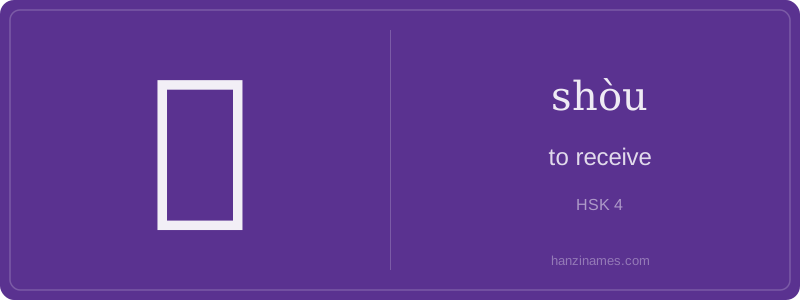
受 is ubiquitous in formal and colloquial contexts: it appears in HSK 4 vocabulary like 接受 (jiēshòu, 'to accept'), 受益 (shòuyì, 'to benefit'), and the common phrase 深受欢迎 (shēn shòu huānyíng, 'highly popular' — literally 'deeply received welcome'). It’s also central to legal and administrative terms: 受理 (shòulǐ, 'to accept and process [an application]') is used daily in government service windows across China, documented in official PRC administrative procedure guidelines.
The character’s form is not pictographic but ideographic: bronze inscriptions (c. 1000 BCE) show 受 as two hands () above 又 (hand), symbolizing the act of handing down and receiving — confirmed by authoritative sources like the *Chinese Etymological Dictionary* (Zhōngguó Gǔwénzì Zìdiǎn). No oracle bone form survives, but its structure consistently reflects intentional, bilateral exchange.
Imagine a crisp autumn morning in Beijing’s Nanluoguxiang alley, where a young teacher hands a handmade red envelope to her student’s grandmother—inside, a gift for the child’s academic achievement. The grandmother smiles warmly and says, '谢谢,我们很受感动。' (Xièxie, wǒmen hěn shòu gǎndòng.) — 'Thank you, we’re deeply moved.' Here, 受 isn’t just passive receipt; it conveys emotional reception, gratitude, and respectful acceptance of goodwill.
The character 受 appears constantly in modern Chinese life: from official documents ('受聘为教授' — appointed as professor) to social media comments ('这波操作我直接受不住了!' — 'I can’t handle this move!'). Its nuance lies in acknowledging impact—whether positive (受惠, benefit), negative (受害, be harmed), or neutral (接受, accept). It implies agency in response, not mere physical taking.
Historically, 受 was standardized in the Qin dynasty’s small seal script and later clerical script. Unlike pictographic characters like 日 (sun), 受 evolved from a compound ideograph: the top part () suggests two hands offering something downward, while the bottom (又) — the radical — represents a hand receiving. This dual-hand gesture visually encodes mutual transfer, making 受 one of Chinese’s earliest semantic compounds expressing relational action.
Example Sentences
Common Compounds
Similar Characters — Don't Mix These Up
Your First Step into Chinese Culture: Get a Chinese Name
Every journey into Chinese begins with a name. Use our free Chinese name generator to create a meaningful, personalized Chinese name that fits you perfectly.
Get My Chinese Name →