叶
Character Story & Explanation
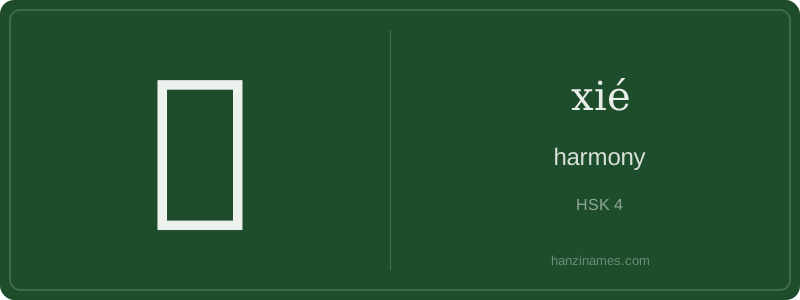
In modern Chinese, 叶 (xié) appears almost exclusively in formal, written contexts expressing harmony—most notably in the state-endorsed slogan 和谐社会 (hé xié shèhuì, 'harmonious society'), widely promoted since 2004 in official media and policy documents. It also occurs in classical idioms like 一唱一和 (yī chàng yī hè), where 和 (hè) means 'to join in song', and 叶 functions as the variant form meaning 'to chime in'—a documented usage in pre-Qin texts like the *Zuo Zhuan*.
The character 叶 originally depicted a tree branch with foliage—but that meaning was later written as 葉 (simplified to 叶). The xié reading is a phonetic loan: the character was borrowed because its Old Chinese pronunciation (*l̥ap) approximated the sound of the harmony-related word, which had no dedicated character. No oracle bone or bronze inscription confirms a pictorial 'mouth + leaf' origin—the 口 radical was added during Han dynasty standardization for classification, not semantic reason.
As a linguistic detective, I begin with the character 叶—whose primary modern reading is yè (meaning 'leaf'), but whose ancient, literary pronunciation xié carries the profound meaning 'to be in harmony'. This dual life reveals a classic case of phonetic-loan usage: the character was borrowed for its sound to express an abstract concept unrelated to its original pictographic form. The xié reading survives almost exclusively in classical compounds and poetic diction, not everyday speech.
The radical 口 ('mouth') hints at vocalization or utterance—fitting for a word denoting harmonious resonance between voices or forces. Though 叶 is now classified under 口 in dictionaries, its earliest forms (in seal script) show no mouth component; the radical assignment came later via structural reanalysis. This reflects how character categorization can shift over millennia, independent of etymological origin.
Crucially, xié is not a standalone verb in modern Mandarin—it appears only in fixed, often archaic expressions like 协同 (xié tóng, 'to coordinate') or 和谐 (hé xié, 'harmony'). Its survival underscores how Classical Chinese semantics persist in formal registers: legal texts, political slogans, and Confucian discourse still invoke xié to evoke moral, social, or cosmic alignment—not botanical foliage.
Example Sentences
Common Compounds
Similar Characters — Don't Mix These Up
Your First Step into Chinese Culture: Get a Chinese Name
Every journey into Chinese begins with a name. Use our free Chinese name generator to create a meaningful, personalized Chinese name that fits you perfectly.
Get My Chinese Name →