味
Character Story & Explanation
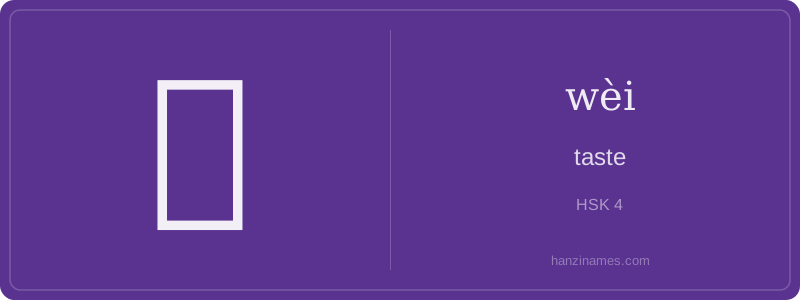
In daily life, 味 is indispensable: restaurant menus list ‘酸味’ (suanwèi, sour taste), cooking shows emphasize ‘调味’ (tiáowèi, seasoning), and people describe art or literature as ‘有味道’ (yǒu wèidào, ‘has flavor’—i.e., richly evocative). Historically, the Qimin Yaoshu (540 CE agricultural manual) uses 味 to classify ingredients by taste properties, and the Song dynasty scholar Zhu Xi wrote of ‘读书之味’ (the ‘taste of reading’) as intellectual delight.
The character’s form is not pictographic but phono-semantic: 口 (mouth) signals semantic domain; 未 (wèi) serves as both phonetic clue and subtle semantic modifier—its original meaning ‘not yet’ implies taste as a *perceptible threshold*, distinguishing edible from inedible, harmonious from jarring. This functional logic reflects how early scribes encoded cognition, not just objects.
Our investigation begins with the oracle bone and bronze inscriptions—though 味 does not appear in earliest forms, it emerges clearly in Warring States bamboo texts and Han dynasty seals. Its structure reveals intent: the 口 (mouth) radical anchors it to sensory experience, while the right component, 未 (wèi), originally meant 'unripe' or 'not yet'—suggesting early conceptualization of taste as a *developing* or *discernible* quality perceived orally.
By the Eastern Han, Xu Shen’s Shuōwén Jiězì (121 CE) formally defines 味 as ‘what the mouth perceives’ (口所受也), confirming its physiological basis. Notably, 味 was never a pictograph of food or flavor—but a *functional compound*: mouth + phonetic/semantic marker. The 未 component also provided pronunciation (wèi), making it a phono-semantic character—a hallmark of mature Chinese script evolution.
This character quickly transcended literal taste: by the Tang dynasty, poets used 味 metaphorically for ‘aesthetic resonance’ (e.g., Du Fu’s ‘poetic flavor’), and Neo-Confucians spoke of the ‘taste of virtue’. Today, 味 carries this dual weight—grounded in biology yet elevated to philosophy, cuisine, and criticism—making it a quiet linchpin in Chinese semiotics of perception.
Example Sentences
Common Compounds
Similar Characters — Don't Mix These Up
Your First Step into Chinese Culture: Get a Chinese Name
Every journey into Chinese begins with a name. Use our free Chinese name generator to create a meaningful, personalized Chinese name that fits you perfectly.
Get My Chinese Name →