咱
Character Story & Explanation
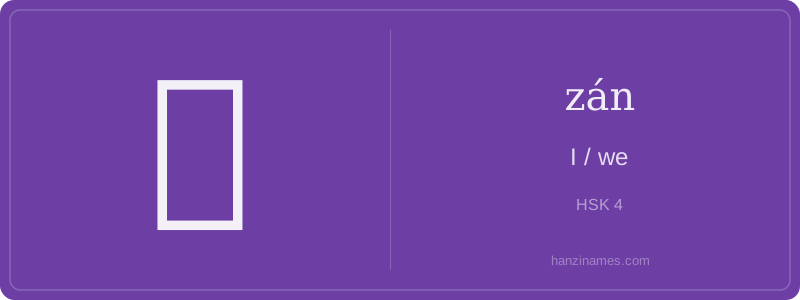
咱 is widely documented in Ming- and Qing-dynasty vernacular literature (e.g., *The Plum in the Golden Vase*, c. 1610) as a northern colloquial pronoun meaning 'I/we'. Today, it remains dominant in Northern Mandarin dialects — especially in Beijing, Hebei, and Shandong — and appears in common phrases like 咱们 (zánmen, 'let’s / we') and 咱家 (zánjiā, 'our home/family'). It’s rarely used in formal writing but thrives in oral communication, media subtitles, and regional TV shows.
The character 咱 has no ancient pictographic origin — it’s a later phonosemantic compound. The 口 (kǒu, 'mouth') radical signals its spoken nature, while the right component 曰 (yuē, archaic 'to say') hints at vocalization — though this is now purely conventional. Modern learners encounter it most often in dialogues where speakers express solidarity: a teacher might say 咱试试 (zán shìshi, 'Let’s try') to encourage a student.
Hi students! Let’s talk about 咱 (zán) — a friendly, informal first-person pronoun meaning 'I' or 'me', but with a special twist: it often includes the listener! Think of it like 'we' in some contexts, especially in Northern China. Unlike the formal 我 (wǒ), 咱 feels warm, familiar, and down-to-earth — used among family, friends, or even teachers speaking to students. It’s not for official documents or formal speeches, but it’s everywhere in spoken Mandarin.
Don’t confuse 咱 with other 'I' words — it carries subtle social nuance. In Beijing or Shandong dialects, saying 咱们 (zánmen) is as natural as saying 'let’s' in English ('Let’s go!' = 咱们走吧!). The character’s 口 (mouth) radical reminds us this is *spoken* language — born from daily conversation, not classical texts. Its simplicity (just 9 strokes!) makes it beginner-friendly, but its usage requires cultural awareness.
At HSK Level 4, 咱 marks your move into authentic, colloquial speech. You’ll hear it in TV dramas, street chats, and even some pop songs. While 我 is neutral and universal, 咱 adds relational warmth — implying closeness or shared identity. Mastering it helps you sound less like a textbook and more like a real person in China. Practice listening for tone and context: if someone says 咱家 (zánjiā), they likely mean 'our family' — not just theirs!
Example Sentences
Common Compounds
Similar Characters — Don't Mix These Up
Your First Step into Chinese Culture: Get a Chinese Name
Every journey into Chinese begins with a name. Use our free Chinese name generator to create a meaningful, personalized Chinese name that fits you perfectly.
Get My Chinese Name →